What the Commercial Real Estate Offering Memorandum Omits
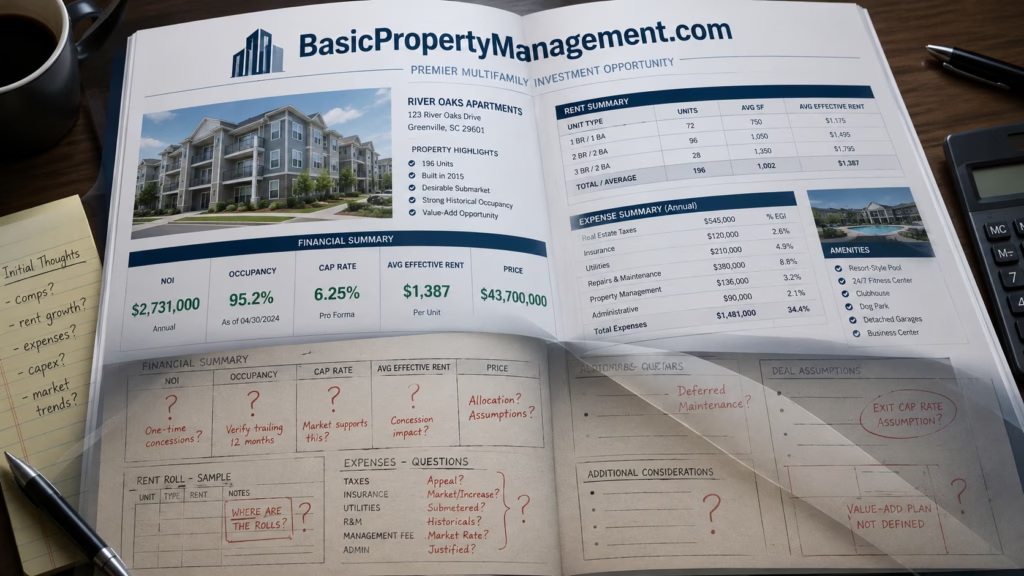
An offering memorandum is designed to make a property worth your attention. It is not designed to underwrite the deal for you.
A commercial real estate offering memorandum can give you the facts needed to start, but its pro forma, market rents, expense assumptions, and investment “upside” still need to survive your own analysis. The fastest way to review one is to make three passes through the deal.
Take Your Real Estate Business to the Next Level
Sign up for our 2X weekly newsletter and receive useful tips on property management, rental property investing, landlord best practices, and tools that help you manage smarter.
Pass One — Strip Away the Sales Story
Your first review should answer a simple question: Is there enough here to justify deeper underwriting?
You do not need to rebuild every cash flow immediately. Start by identifying what the seller and broker want you to believe about the property.
Common investment highlights include:
- Below-market rents
- Strong occupancy
- Long-term tenants
- Value-add potential
- Limited competing supply
- Attractive assumable financing
- Recent renovations
- Strong population or employment growth
- Opportunity to increase rents
- Favorable basis relative to replacement cost
Treat each statement as a hypothesis rather than a conclusion.
“Below-market rents” should become: How far below market, and when can I actually raise them?
“Strong occupancy” becomes: Which tenants create that occupancy, and when do their leases expire?
“Value-add opportunity” requires another question: How much capital and time will it take to capture that value?
This approach prevents the strongest marketing language from becoming an underwriting assumption before you have tested it.
Look for timing hidden inside the upside
Timing can radically change the value of an opportunity.
Suppose an OM shows a retail tenant paying $18 per square foot while current market rent appears to be $24. A six-dollar spread sounds compelling.
Now discover that the tenant has seven years remaining on the lease plus two fixed-rate renewal options.
The rent gap still exists, but you may not capture it during your planned hold period. NAIOP guidance on entering high-growth markets makes a similar distinction between market rent and realizable rent: projected upside only creates investment value when you can actually capture it within the relevant timeframe.
The same reasoning applies to vacancies, lease renewals, redevelopment, parking income, expense reductions, and future financing.
Pass Two — Rebuild the Economics From the Bottom Up
Once the property survives your first screen, stop underwriting from the OM’s summary page.
Build your own numbers.
A polished commercial real estate offering memorandum may present a cap rate, projected NOI, cash-on-cash return, internal rate of return, or several years of pro forma income. Those metrics depend entirely on the assumptions underneath them.
Your task is not to decide whether the broker calculated the numbers correctly. You need to decide whether you agree with the inputs.
Start with actual income
Separate current contractual income from projected income.
Ask for the current rent roll and compare it with the OM. Review:
- Contract rent
- Lease start and end dates
- Escalations
- Renewal options
- Expense reimbursements
- Free-rent periods
- Percentage rent, when applicable
- Tenant security deposits
- Vacant space
- Month-to-month tenants
A rent roll can reveal risks that disappear inside an occupancy percentage.
For example, 95% occupancy looks strong until you discover that one tenant occupies 35% of the building and its lease expires two years after acquisition.
Concentration and rollover matter as much as the headline occupancy number.
Reconstruct NOI instead of accepting it
Next, work through the operating statement.
Compare trailing financial performance with the pro forma shown in the OM. Focus on the differences.
If current NOI equals $600,000 and the marketed NOI equals $725,000, determine exactly where the additional $125,000 comes from.
Perhaps the forecast assumes higher rents. Maybe management fees disappear. Vacancy could fall. Expenses might decline. New tenants may fill existing space.
Each change needs an explanation and a probability.
Crexi’s commercial real estate underwriting guidance emphasizes validating assumptions with property records, lease information, comparable transactions, and current market data rather than relying entirely on estimates or stale inputs.
A seller’s pro forma tells you the argument for the price. Your pro forma tells you whether you should pay it.
Watch the Expenses That Make NOI Look Better
Income usually gets more attention, but understated expenses can distort value just as quickly.
Compare the OM with historical operating statements for:
- Property taxes
- Insurance
- Utilities
- Repairs and maintenance
- Payroll
- Landscaping
- Security
- Management fees
- Contract services
- Administrative expenses
Then ask what could change after acquisition.
Will property taxes change under local assessment rules? Has the insurance quote been updated? Does payroll reflect adequate staffing? Are repairs unusually low because the owner deferred work before the sale?
Do not automatically eliminate an expense because you think you can operate the property more efficiently. Underwrite the improvement only when you have a credible plan for producing it.
Separate recurring performance from temporary benefits
One unusually good year can make a property appear stronger than it is.
Free rent may have expired. A large repair could have occurred the previous year. Temporary vacancy might suppress trailing income, while a one-time reimbursement could inflate it.
Concessions deserve particular attention because the amount shown in a pro forma may not reflect the cost required to maintain occupancy over time. A.CRE’s analysis of stabilized NOI and concessions explains how buyers and sellers may underwrite concessions differently and why leasing costs need to reflect the realities of tenant retention and replacement.
Normalize unusual items before converting NOI into value.
Pass Three — Investigate What You Cannot See
The third pass may be the most important because it focuses on what the OM does not tell you.
Marketing packages have limited space. Some issues simply do not appear until you request supporting documents or begin formal due diligence.
Read the leases, not just the rent roll
A rent roll summarizes lease economics. The actual leases determine the rights and obligations.
Review provisions involving:
- Renewal options
- Termination rights
- Expansion or contraction rights
- Expense caps
- Exclusive-use clauses
- Co-tenancy provisions
- Assignment rights
- Tenant improvement obligations
- Repair responsibilities
- Purchase options
- Rights of first refusal
One clause can change the economics represented by an entire row in the rent roll.
A seemingly favorable lease expiration may look different when the tenant controls multiple renewal options below market.
Find the capital the OM does not subtract
Deferred capital expenditure often sits outside the advertised NOI.
Walk the property and investigate the condition of:
- Roofs
- HVAC equipment
- Elevators
- Parking lots
- Building envelope
- Plumbing
- Electrical systems
- Fire and life-safety systems
- Common areas
- Tenant spaces
A $700,000 NOI does not provide the same return if you need to spend $1.5 million shortly after closing.
Create a separate capital schedule instead of trying to bury major replacements inside operating expenses.
Test the Physical and Legal Assumptions Too
Commercial real estate performance depends on more than rents and expenses.
Access, parking, easements, signage rights, environmental conditions, reciprocal easement agreements, zoning, tenant exclusives, and shared-maintenance obligations can affect how you operate or reposition the property.
These documents deserve economic analysis, not merely legal review.
NAIOP acquisition guidance highlights governance documents, parking, access, signage, shared-maintenance obligations, and tenant exclusives as issues that can materially affect property performance and therefore need to enter the investment analysis.
If a restriction prevents you from executing the business plan, lower projected returns are not the problem. The business plan itself may not work.
Challenge the Exit Before You Trust the Return
Projected IRR often depends heavily on what happens several years from now.
Check the exit assumptions carefully.
If the OM assumes you buy at a 7% cap rate and sell five years later at 6%, the lower exit cap creates additional projected value even without operational improvement.
That may happen. It should not automatically become your base case.
Stress-test:
- Exit cap rate
- Future NOI
- Sale costs
- Hold period
- Interest rates
- Refinancing proceeds
- Tenant rollover
- Required capital expenditures
Run a downside case that removes some of the optimistic assumptions.
A deal that only works when rents grow quickly, expenses remain flat, occupancy stays near 100%, and the exit cap rate compresses has very little margin for error.
Turn Missing Information Into Your Next Request
By the end of your review, the OM should generate questions rather than answer all of them.
Build your next document request around the gaps you found.
You may need:
- Current rent roll
- Trailing 12-month operating statement
- Prior-year financials
- Copies of leases and amendments
- Property tax bills
- Insurance information
- Utility history
- Capital expenditure records
- Service contracts
- Environmental reports
- Survey and title materials
- Existing debt information
- Recent engineering or property-condition reports
You do not need every document before making an initial pricing decision. However, you should know which assumptions remain unverified.
That distinction matters.
An assumption you consciously plan to verify creates a diligence item. An assumption you forget you made becomes investment risk.
Make the OM Prove the Deal
A commercial real estate offering memorandum should help you decide where to look, not tell you what to think.
Use the first pass to strip away the marketing language. Rebuild the income and expenses during the second. Spend the third pass investigating the lease terms, capital requirements, physical condition, legal constraints, and exit assumptions the summary pages cannot capture.
A strong OM can make a complicated property understandable.
Strong underwriting takes the next step and determines whether the property is actually worth the price.