Managing Elevated Radon in an Occupied Rental
A radon test reports 6.7 pCi/L while a tenant is living in the rental. The landlord now needs to determine whether the test was performed correctly, what the result means, whether another measurement is needed, and how to coordinate any resulting work without leaving the tenant uncertain about what happens next.
When testing identifies radon in occupied rental property, treat the result as a building-maintenance issue that needs verification and follow-through. Give the tenant the actual reading, confirm the testing method, arrange the appropriate follow-up measurement, and coordinate professional mitigation when the results support it. Keep the work order open until another test verifies how the property performs after mitigation.
Get Actionable Property Management Tips Twice a Week
Want smarter systems for managing rentals, screening tenants, handling maintenance, and improving property performance? Sign up for our 2X weekly newsletter and get practical property management and real estate investing insights delivered straight to your inbox.
Understand What Radon Is and Why the Result Requires Attention
Radon is a naturally occurring radioactive gas that comes from the breakdown of radioactive materials in soil and rock. It can move through the ground and enter a building through foundation cracks, construction joints, openings around utility penetrations, sump areas, crawlspaces, and other paths between the building and the soil.
You cannot see or smell radon. Testing is therefore the only practical way to determine how much is present inside a rental.
The CDC’s radon health guidance identifies radon as the second-leading cause of lung cancer deaths in the United States after cigarette smoking and explains that radioactive particles produced as radon decays can become trapped in the lungs. The health concern relates to exposure over time rather than an immediate poisoning event.
Smoking substantially increases the lung-cancer risk associated with radon exposure. A landlord does not need to make assumptions about a tenant’s health or smoking history, however. Manage the measured condition of the property and give the tenant the information needed to understand what management is doing about it.
EPA recommends reducing radon when the measured level is 4 picocuries per liter, or pCi/L, or higher and considering reduction at levels between 2 and 4 pCi/L.
Know Where Higher Radon Potential Occurs Without Relying on Geography Alone
Radon can occur anywhere in the United States, but geological conditions make elevated indoor levels more common in some areas.
The EPA Map of Radon Zones classifies counties by predicted radon potential, with Zone 1 representing the highest potential for average indoor levels above 4 pCi/L. Higher-potential areas are common across parts of the Upper Midwest, northern Plains, Mountain West, Appalachia, and Northeast.
That map helps explain regional risk, but it does not tell you the radon concentration in a particular rental. EPA specifically notes that homes with elevated levels have been found in all three zones.
Two houses on the same street can also produce different results because foundation design, soil conditions, pressure differences, building alterations, and pathways from the soil into the structure vary. A property in a lower-potential county still needs an actual test if you want to know its radon level.
Verify How the First Test Was Performed
Before deciding what to do with an elevated result, review the test itself.
Record the device type, test dates, duration, location, laboratory or testing company, and reported result. Determine whether the device remained in the required position for the full testing period and whether the occupants followed the instructions that accompanied it.
This review becomes particularly important when a tenant conducted the first test. Do not disregard a tenant-provided result simply because management did not order it. Instead, determine whether the test gives you enough information to rely on the result or whether you need a professionally administered measurement.
A device left beside an open window or removed before its required exposure period may not provide the same basis for a decision as a correctly placed test with a complete laboratory report.
Keep the original report even if you decide to retest. It forms part of the property’s radon history and can help explain why management ordered the next measurement.
Tell the Tenant the Result and the Next Testing Step
Give the tenant the actual number rather than describing the result only as “high” or “elevated.” Include where management tested, when the test occurred, and what you plan to do next.
EPA’s Consumer’s Guide to Radon Reduction uses 4 pCi/L as the recommended level for taking action and explains that one long-term test or the average of two short-term tests can provide the basis for a mitigation decision.
That information gives the tenant useful context. A 4.2 pCi/L result and a 22 pCi/L result both warrant attention, but the second reading creates a stronger reason to obtain confirmation quickly.
Avoid speculating about how long the tenant has been exposed or what the reading means for an individual’s health. Tell them what management knows: the measured result, how you intend to confirm it, when the next test will occur, and when you expect to provide another update.
If the tenant raises medical concerns, keep the property-management response focused on testing and reducing the building’s radon level.
Choose the Follow-Up Test Based on the Initial Reading
A single short-term result at or above 4 pCi/L normally calls for a follow-up measurement before you base the mitigation decision on that number alone.
A second short-term test provides a faster answer. A long-term test, which runs for more than 90 days, gives a better estimate of the property’s average radon concentration over time.
The initial reading can influence that choice. For a moderately elevated result, management may have enough flexibility to choose either approach based on the property and testing schedule. When the first short-term result exceeds roughly twice EPA’s 4 pCi/L action level, EPA guidance favors conducting another short-term test promptly rather than waiting months for a long-term measurement.
For example, a properly conducted test at 5.1 pCi/L may support either a second short-term test or a long-term measurement. A result of 12 pCi/L gives management a stronger reason to confirm the reading quickly and move toward mitigation if the second result remains elevated.
Keep both short-term reports if you use that approach. Do not discard the higher reading and make the decision from the lower result alone.
Control Test Conditions in the Occupied Unit
Occupied rentals require more coordination because normal resident activity can interfere with some short-term tests.
Give the tenant written instructions before the test begins. For short-term measurements that require closed-building conditions, explain when exterior windows and doors need to remain closed, while allowing normal entry and exit. Tell the tenant not to move, cover, unplug, or otherwise disturb the device.
A qualified tester should choose the measurement location under the applicable testing protocol. In a typical residence, that means testing an appropriate regularly occupied area on the lowest level used or suitable for use rather than placing the device wherever it causes the least inconvenience.
Heating and cooling systems generally continue operating normally, but the tester should identify any equipment or conditions that could affect the measurement.
Do not assume a large difference between two readings proves that someone interfered with the test. Radon levels fluctuate. If the tester identifies an actual testing problem, document the issue and replace the invalid measurement.
Hire a Qualified Mitigation Contractor After Elevated Levels Are Confirmed
Once the results support mitigation, the next task is building work rather than additional interpretation of the number.
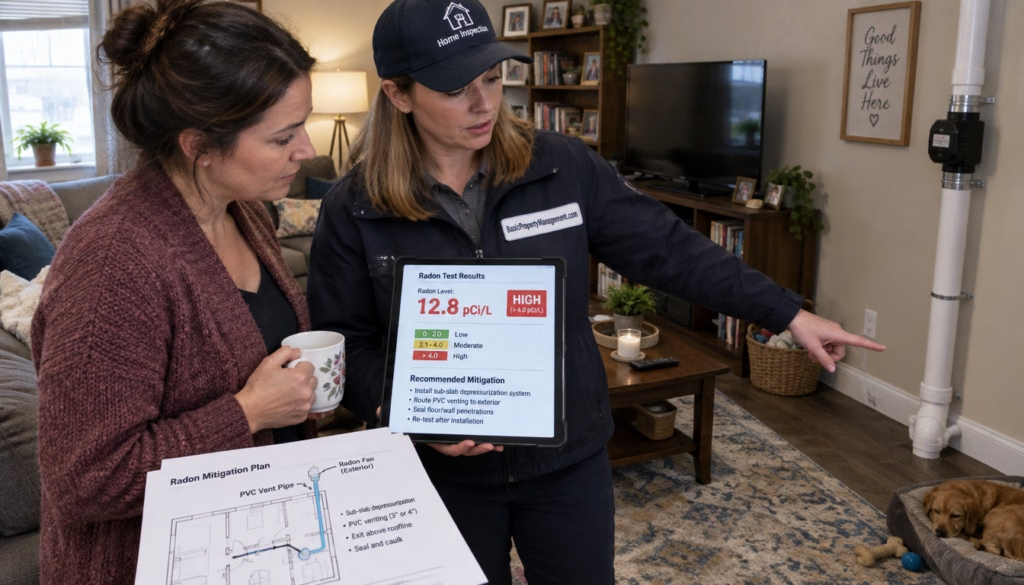
Radon professionals commonly use active soil depressurization to draw soil gas from beneath the building and exhaust it outside before it enters the occupied space. The correct design depends on the foundation. A basement, slab-on-grade house, crawlspace, or property with several foundation types may require a different configuration.
Ask the contractor to inspect the property before providing the final scope. The proposal should identify the mitigation method, suction point or points, pipe route, fan location, electrical work, exhaust location, system indicator, warranty, and post-installation testing plan.
Check the qualification requirements or recognized credentials used in the property’s state before hiring the contractor. Radon work is specialized enough that a general handyman should not design a mitigation system simply from a diagram or another property’s installation.
Coordinate Installation Around the Tenant’s Use of the Rental
An occupied installation can involve a basement, crawlspace, utility room, garage, closet, bedroom, or finished living area. Give the tenant enough information to prepare the necessary space without making them responsible for managing the project.
Tell them which areas the contractor needs, when technicians will arrive, and what belongings need to move. If the installer needs a six-foot work area around one basement wall, ask for that area rather than ordering the tenant to clear the entire basement.
Explain expected disruption as well. Drilling through a slab, routing pipe, installing a fan, sealing openings, and completing electrical work can create noise and temporary restrictions even when the contractor finishes in one day.
Plan for pets, locked rooms, parking, gates, and any return visit before the work begins. Follow the normal access procedure used for occupied maintenance rather than treating the radon project as open-ended permission to enter the rental.
Require Post-Mitigation Testing Before Closing the Work Order
A completed installation does not establish that the indoor radon level has fallen. The fan can run and the system indicator can look normal while the property still needs additional adjustment.
Arrange post-mitigation testing when you schedule the installation so the verification step does not get lost after the contractor leaves. EPA guidance calls for testing after the system has operated for at least 24 hours and within 30 days after installation.
Use the same care with test placement and building conditions that you used during confirmation. Keep the result with the earlier reports so you can compare pre- and post-mitigation levels directly.
If the new measurement remains elevated, return the result to the mitigation contractor. The contractor may need to inspect airflow, add a suction point, improve sealing, alter fan capacity, or make another system adjustment.
Keep the project open until testing establishes how the corrected system performs.
Show the Tenant How to Recognize a System Problem
Most active mitigation systems include an indicator that allows someone to see whether the system is maintaining suction. Make that indicator part of the handoff after installation.
Ask the contractor to show management what normal operation looks like. Then give the tenant a simple instruction such as reporting a changed indicator, unusual fan noise, disconnected power supply, or visible damage rather than attempting to repair the system.
Collect the contractor’s operating instructions, fan information, warranty, photographs, and electrical details before closing the installation work order.
This creates a clear division of responsibility. The tenant can report an observable problem, while management arranges the diagnosis and repair.
Add Radon Verification to Recurring Property Maintenance
A mitigation system becomes permanent building equipment once installed. The property file should treat it that way.
Check the visible system indicator during routine inspections and look for damage to accessible piping or electrical components. Fans can eventually fail, and construction work can affect the pressure conditions the system was designed to control.
EPA recommends retesting a mitigated home periodically, commonly at least every two years, and retesting after significant structural changes that could affect radon levels.
Add those dates to our rental property maintenance schedule so future inspections and turnover work do not depend on someone remembering why a pipe and fan were installed years earlier.
Basement finishing, foundation additions, crawlspace alterations, or other work involving the lower portion of the building should also prompt a review of whether another radon measurement belongs in the project closeout.
Keep the Testing and Mitigation Record With the Property
The radon file should remain with the rental after the current tenant leaves.
Keep the initial result, confirmation test, tenant communications related to testing and access, contractor proposal, installation invoice, system specifications, warranty, post-mitigation result, subsequent tests, and repair history together.
Future managers can then see what triggered mitigation, how the contractor addressed it, whether post-installation testing verified the reduction, and when another measurement is due.
Radon in occupied rental property requires more than ordering a mitigation system after one surprising number. Verify the measurement, explain the result accurately, select the appropriate confirmation method, coordinate the work around an occupied home, and test again after mitigation.
The process is complete when management has evidence that the system reduced the measured level and a maintenance record that keeps the equipment and future testing visible.