How to Find Rental Arbitrage Properties That Actually Work
Rental arbitrage can look profitable on a listing page and fail as soon as the lease starts. If you want to know how to find rental arbitrage properties, the real work is screening legality, landlord permission, demand, and downside before you pay a deposit. This guide shows how to narrow ordinary rentals into candidates worth underwriting—and when to walk away.
Learn How Successful Landlords Manage Better Rentals
Join our 2X weekly newsletter for clear, actionable guidance on property management, leasing, tenant issues, rental property operations, and real estate investing strategies you can actually use.
Pick the Market Before the Unit
Rental arbitrage reverses the usual acquisition process. You are leasing someone else’s property and relying on furnished rental income to cover rent, utilities, operating costs, setup costs, and profit.
Before saving listings, check the city and county rules that affect the stay lengths you plan to offer. Review zoning, STR registration, licensing, hotel occupancy taxes, HOA or condominium restrictions, and building-level limits.
Dallas shows why this comes first. The city’s current short-term rental information defines an STR as a full or partial unit rented for fewer than 30 consecutive days or one month, whichever is less. It also notes that enforcement of two 2023 STR ordinances remains subject to a temporary injunction, while existing rules on property standards, noise, nuisances, and other issues can still apply.
Do not rely on an old article or a neighboring city’s rules. Check the jurisdiction again when a specific address reaches your short list.
Define the Property You Are Actually Looking For
A broad search produces too many listings and makes weak candidates easier to rationalize.
Write down the property you want before opening Zillow, Apartments.com, or local listing sites. For a corporate-housing or STR strategy, your profile might call for two bedrooms, parking, in-unit laundry, a practical floor plan, proximity to major employment centers, and rent below a firm ceiling.
The guest profile should influence that list. Traveling medical professionals, relocating employees, project teams, and weekend visitors do not value every feature the same way.
Property managers should add operational fit. Easy access, durable finishes, straightforward parking, responsive maintenance, and a layout that cleans efficiently can be worth more than an impressive listing photo.
Use listing sites, brokers, property managers, individual landlords, and smaller multifamily owners to build the candidate pool. A rental that has sat longer than nearby units or recently reduced its asking rent may give the owner more reason to consider a corporate lease, but the numbers still have to work.
The DFW Candidate Has to Earn the Landlord Call
One common mistake is pitching owners before you know whether the unit economics make sense.
Assume you find a two-bedroom DFW rental asking $2,200 per month, plus $150 in required fees. Parking is included, the location fits your guest profile, and the layout looks workable.
Estimate the full monthly cost before contacting the owner:
- Base rent and mandatory fees
- Utilities and internet
- Insurance
- Cleaning costs you do not recover
- Platform or booking costs
- Supplies and linens
- Maintenance and replacement reserves
- Licensing or tax-administration costs
- Furniture and setup costs spread over a realistic period
A cheap lease with expensive operations can be worse than a higher-rent property that is easier to run.
Your first screen should answer a simple question: Is there enough spread to justify more work?
Your STR Comps Should Be Able to Compete With the Unit
Revenue estimates are only as good as the properties behind them.
A two-bedroom apartment should not inherit the ADR of a renovated four-bedroom house with a pool because both sit in the same ZIP code. Match the candidate as closely as possible on property type, bedroom and bathroom count, guest capacity, parking, location, amenities, and quality.
AirDNA’s Rentalizer methodology offers a useful example. Its projections use nearby listings with similar bedroom, bathroom, and guest configurations and factor in seasonality and rental demand. You can also refine the comp set when a property is not a good match.
Remove obvious outliers and look at monthly performance rather than relying only on an annual average. Check whether the strongest comp has better amenities, more reviews, superior furnishing, or a location advantage your candidate will not share.
For how to find rental arbitrage properties that can hold up after launch, the useful number is not the highest ADR you can find. It is the revenue range supported by properties you could realistically compete with.
The Weak Month Is the Real Test
Return to the $2,200 rental.
Suppose your comp work supports a base-case ADR of $190 and 70% occupancy. In a 30-day month, that equals about 21 occupied nights and $3,990 of gross booking revenue before adjusting for cleaning fees, discounts, platform costs, and other charges.
Now assume recurring monthly costs reach $3,250.
The preliminary spread is only $740.
A few additional vacant nights, a lower seasonal ADR, an appliance failure, or higher cleaning expense could erase most of it. Rather than trying to prove the property works, try to break the forecast.
Find the break-even occupancy
If effective revenue averages $180 per occupied night after booking-related costs, $3,250 of monthly expenses require roughly 18 occupied nights to break even. That is about 60% occupancy in a 30-day month.
Compare that threshold with monthly performance from your comp set. If similar rentals fall into the low-50% range during slower periods, the candidate has very little room for error.
Run a downside month with lower occupancy and lower ADR at the same time. If the lease becomes uncomfortable under a reasonable downside case, reject it before the deposit makes that decision harder.
Landlord Approval Is a Separate Gate
Once the numbers survive, explain the intended use to the landlord or property manager.
Do not hide the model.
State whether the company will use the unit for short stays, corporate housing, medium-term occupancy, or a permitted combination. Be ready to address screening, payment responsibility, insurance, cleaning, maintenance, noise, occupancy limits, inspections, and damage.
The lease or an addendum should expressly authorize the use. A casual verbal approval can fall apart when management changes, a neighbor complains, or the owner later sees the property advertised online.
Keep two questions separate:
Does the owner allow it?
Do the governing rules allow it?
You need satisfactory answers to both. Landlord approval does not override local law, HOA restrictions, condominium documents, or insurance terms.
Nightly Stays Are Not the Only Model
A furnished rental that looks marginal as a nightly STR may work differently with 30-, 60-, or 90-day stays.
Corporate assignments, relocations, traveling professionals, insurance-displacement households, and project teams can produce longer bookings. Fewer turns may reduce cleaning costs, vacancy between guests, and management time.
Texas also treats longer stays differently for hotel occupancy tax. The Texas Comptroller’s hotel occupancy tax guidance explains that guests who occupy a room for 30 or more consecutive days without interruption can qualify as permanent residents for hotel-tax purposes, subject to the stated requirements.
That tax treatment does not decide whether a lease, HOA, zoning rule, or other restriction allows your use. It does show why stay length belongs in the underwriting.
For the DFW candidate, model the nightly strategy and a 30-plus-day corporate-housing strategy separately. A lower nightly equivalent rate may still produce a better result if occupancy is steadier and turnover costs fall.
Thin Margins Usually Show Themselves – If You Look
Some properties only work because every assumption leans in your favor.
Watch for a forecast that depends on peak-season pricing for much of the year, one exceptional comp, break-even occupancy close to expected occupancy, or setup costs that consume most of your available cash.
Practical problems count too. Verbal-only landlord approval, unclear HOA rules, costly early termination, difficult parking, expensive furnishing requirements, or dependence on one major employer can turn a thin spread into a loss.
Rejecting weak properties is part of how to find rental arbitrage properties efficiently. Every bad candidate you eliminate protects capital and leaves more time for the few that deserve serious underwriting.
One Page Before You Sign
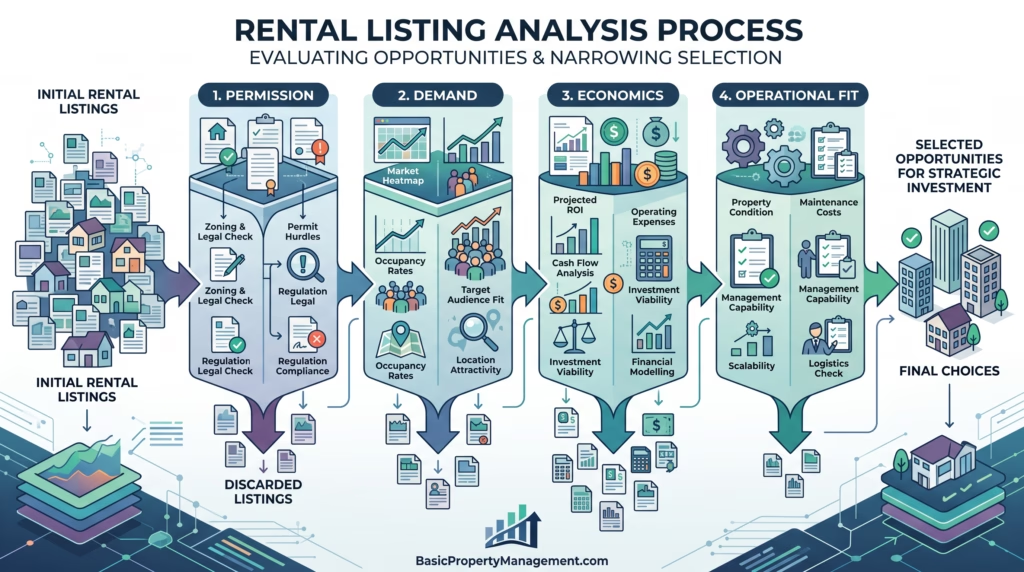
Before paying a deposit, reduce the candidate to four questions:
| Test | What You Need | Pass Signal | Concern |
|---|---|---|---|
| Permission | Legal use and written owner approval | Both confirmed | Either is unclear |
| Demand | Comparable furnished rentals | Several credible comps | One outlier drives forecast |
| Economics | Base and downside analysis | Margin survives slower periods | Needs peak performance |
| Operations | Practical guest and management fit | Easy to run consistently | Parking, access, or turns create friction |
The detailed underwriting may contain dozens of assumptions. Your lease decision should still make sense when reduced to the issues that can kill the deal.
Walk Away From the Property You Cannot Defend
Learning how to find rental arbitrage properties is less about discovering secret listings than eliminating rentals that should never reach the lease stage.
Choose a jurisdiction where the intended stay model is permitted or has a clear legal route. Build the property profile around the guests you plan to serve, use genuinely comparable furnished rentals to estimate revenue, and put the candidate through a weak month before approaching the landlord.
A good arbitrage property does not need heroic occupancy or the neighborhood’s highest ADR.
It needs written permission, credible demand, enough margin for ordinary problems, and numbers you can defend before the lease begins.