Bad Property Manager Signs Owners Often Miss
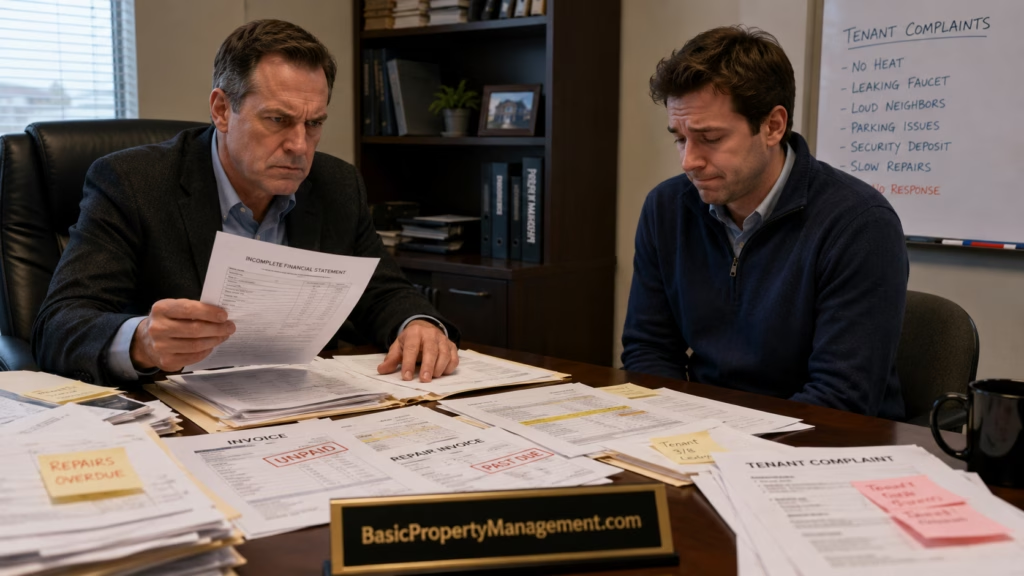
Bad property manager signs are not always dramatic. Rent may still arrive most months, the property may remain occupied, and no major emergency may have occurred. From a distance, the management arrangement can appear acceptable.
The deeper problems often show up as missing information. Your questions take too long to answer. Monthly reports become less detailed. Repair invoices lack documentation. Tenants contact you directly because they cannot get a response. Charges appear on your statement without a clear explanation.
One isolated mistake does not necessarily mean you hired the wrong company. A repeated pattern, however, may indicate weak systems, poor supervision, or a manager who is no longer giving your property adequate attention.
Get Practical Property Management Tips Twice a Week
Want smarter systems for managing rentals, screening tenants, handling maintenance, and improving property performance? Sign up for our 2X weekly newsletter and get practical property management and real estate investing insights delivered straight to your inbox.
Poor Management Usually Appears as Missing Evidence
A capable property manager should be able to show what happened at the property, what money was collected, what expenses were paid, and what action remains open.
Professional standards such as the IREM Code of Professional Ethics emphasize competent management, accurate reporting, proper handling of client funds, and loyalty to the owner’s interests. You should not need to rely entirely on verbal reassurance.
When something goes wrong, ask for the record.
If rent is late, review the tenant ledger and collection notes. If a repair cost $900, request the work order, invoice, approval record, and completion evidence. If a tenant complained, look at the communication timeline and manager response.
The absence of documentation may be more important than the explanation you receive.
The Seven-Signal Owner Dashboard
Use the following signals together rather than judging the manager from one incident.
| Warning signal | What you may notice | Risk to the property |
|---|---|---|
| Slow communication | Emails and calls remain unanswered for days | Delayed decisions and weak owner oversight |
| Missing reports | Statements arrive late or skip important details | Accounting errors may remain hidden |
| Weak maintenance records | Charges appear without invoices, photos, or work orders | Overbilling, repeat repairs, and poor vendor control |
| Repeated tenant complaints | Tenants contact you about unresolved issues | Turnover, property damage, or legal exposure |
| Unexplained charges | Fees do not match the agreement or supporting documents | Reduced cash flow and loss of trust |
| No proactive advice | You hear only about problems after they become urgent | Missed renewals, deferred maintenance, and vacancy risk |
| Staff turnover or handoff confusion | You repeatedly explain the property to new contacts | Lost knowledge and inconsistent service |
Communication and Reporting Failures
A property manager does not need to respond instantly to every routine message. But you should know the expected response time, who is responsible for your account, and how urgent issues are escalated.
A bad pattern develops when:
- Routine questions remain unanswered
- Different staff members give conflicting information
- The manager responds only after repeated follow-up
- You learn about tenant or property issues weeks later
- Promised reports or documents never arrive
Monthly reporting should also be predictable. You should receive a statement showing income, expenses, management fees, owner distributions, reserves, and relevant tenant balances.
The Oregon Real Estate Agency’s property management guide, while specific to Oregon licensees, illustrates the level of accounting discipline owners should expect: property management records should support receipts, disbursements, owner ledgers, tenant ledgers, and regular reconciliation.
If a statement changes format every month or presents unexplained totals, you cannot evaluate the property properly.
Maintenance and Tenant Evidence
Maintenance is where weak management often becomes expensive.
A complete repair record should normally identify the tenant’s original report, date received, urgency, vendor, approval, work performed, amount charged, and completion status. Larger or visual repairs may also justify estimates and photographs.
Warning signs include:
- Several invoices for the same unresolved problem
- Round-number charges without itemization
- Vendor names missing from statements
- No proof that work was completed
- Repairs divided into smaller amounts below your approval limit
- Emergency pricing used for non-emergency work
- Repeated use of an affiliated vendor without disclosure
The North Carolina Real Estate Commission’s trust-account review guidance identifies property management statements, invoices, bills, contracts, leases, and vendor legitimacy as records deserving review. Although specific legal requirements vary, the principle applies broadly: an owner should be able to trace a property expense back to real work and a legitimate vendor.
Follow the Money, Not the Explanation
Unexplained charges do not always mean dishonesty. They may result from weak bookkeeping, poorly configured software, or staff who do not understand the management agreement.
You still need an answer.
Compare each fee with the contract. Review monthly management fees, leasing fees, renewal charges, inspection fees, maintenance markups, technology charges, postage, vacancy fees, project-management fees, and cancellation terms.
For every unfamiliar charge, ask:
- Which section of the management agreement authorizes it?
- What service was provided?
- When was the service completed?
- Is there an invoice, work order, or other supporting document?
- Was owner approval required?
- Is the charge recurring or one-time?
- Is any part paid to an affiliated business?
Do not accept “that is our normal fee” if the charge is not supported by the agreement you signed.
Also compare gross rent collected with the amount deposited to you. The difference should be explainable through documented expenses, reserves, fees, tenant credits, or timing.
Listen to Tenant Complaints Without Automatically Taking Sides
A tenant complaint does not prove the manager performed poorly. Some complaints involve denied requests, valid lease enforcement, or dissatisfaction with a lawful decision.
Repeated complaints about the same operational issue deserve attention.
Examples include:
- Repairs are reported but not scheduled
- Vendors arrive without notice
- Calls and messages are ignored
- Payment records are inaccurate
- Lease documents contain errors
- Security or safety concerns remain unresolved
- The tenant receives inconsistent instructions
You do not need to bypass the manager and begin directing the tenant yourself. That can undermine the management relationship. Instead, ask the manager for the request history, communication log, work-order status, and resolution plan.
Then compare the manager’s record with the tenant’s account.
If several unrelated tenants report the same communication or maintenance problems, the issue is less likely to be an isolated personality conflict.
Run a 30-Day Management Audit
Before terminating the agreement, conduct a focused review. This gives the manager an opportunity to explain missing information and helps you determine whether the problem is one bad month or a failing system.
Request the following for the previous six to twelve months:
- Monthly owner statements
- Tenant ledgers and current balances
- Bank or trust-account activity relevant to your property
- Vendor invoices and work orders
- Open maintenance requests
- Inspection reports and photographs
- Current lease and addenda
- Renewal and expiration schedule
- Tenant notices and documented violations
- Management and leasing fees charged
Next, select three transactions and trace each one from beginning to end.
For a rent payment, confirm the tenant charge, receipt, deposit, management fee, and owner distribution.
For a repair, confirm the request, authorization, vendor invoice, markup or coordination fee, and completion evidence.
For a lease renewal, confirm the market analysis, tenant communication, signed document, rent change, and renewal fee.
If the manager cannot reconstruct ordinary transactions, the reporting problem may be structural.
Separate a Service Problem From a Contract Problem
Sometimes the manager is performing exactly as the agreement requires, but the agreement provides less service than you expected.
For example, periodic inspections may not be included. The manager may have broad authority to approve repairs. Vendor markups may be expressly permitted. Owner statements may be delivered only after a specified date.
In that case, the problem may be the contract rather than a breach of it.
You may be able to renegotiate:
- Response-time expectations
- Reporting frequency
- Invoice access
- Repair approval limits
- Inspection schedules
- Bid requirements
- Renewal procedures
- Dedicated account contacts
- Performance review meetings
Put revised expectations in writing. Verbal promises made after a complaint can disappear when staff members change.
Correct the Relationship—or Replace the Manager
After the audit, place the problems into three categories.
Correctable: A reporting error, staff transition, or isolated communication failure that the company acknowledges and fixes.
Recurring: Repeated delays, missing documents, weak maintenance control, or billing confusion despite prior discussions.
Critical: Mishandled funds, undisclosed conflicts, ignored habitability concerns, false records, unauthorized spending, or refusal to provide owner documents.
A correctable problem may justify a written improvement plan with deadlines. A recurring pattern may justify reviewing alternatives. A critical issue may require prompt legal, accounting, insurance, or regulatory advice.
Before terminating, read the cancellation section of the management agreement. Confirm notice requirements, termination fees, tenant communication, transfer of deposits, delivery of keys, vendor obligations, open work orders, final accounting, and access to leases and records.
Bad property manager signs should not be judged from frustration alone. Use reports, invoices, tenant records, response times, and contract terms to measure performance.
A good manager gives you visibility even when the news is unfavorable. When information repeatedly disappears, explanations replace evidence, and basic records become difficult to obtain, the management relationship may no longer be protecting your property.