
Fair Rental Days vs. Personal Use Days: Avoid Tax Mix-Ups
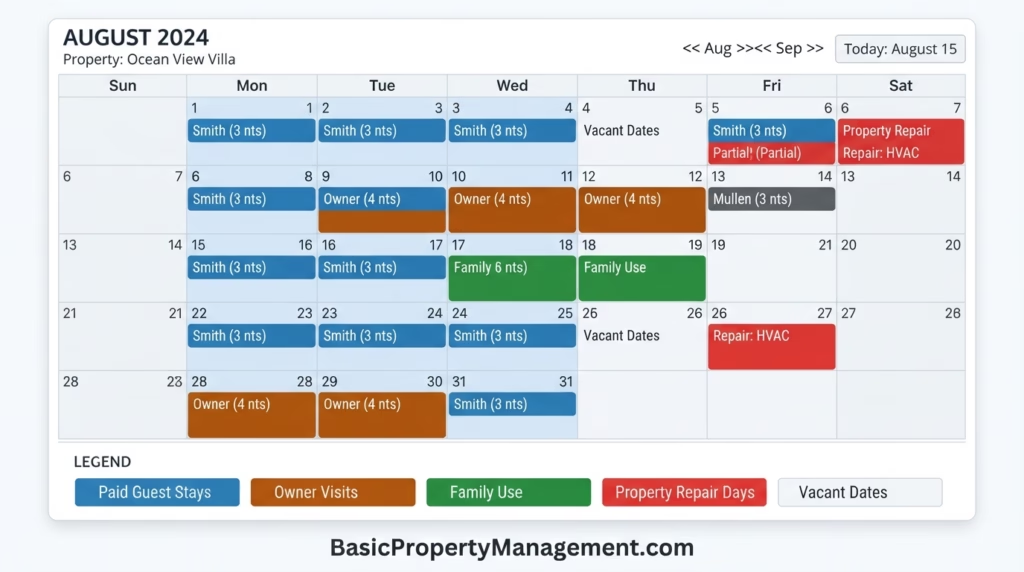
A booked night, a family visit, and a weekend spent repairing the deck may look similar on a rental calendar. The IRS may classify all three differently.
That distinction affects the fair rental and personal-use totals reported on Schedule E. It can also change how expenses are divided and whether deductions are limited under the vacation-home rules.
The correct classification depends on who used the property, what they paid, and why they were there.
Learn How Successful Landlords Manage Better Rentals
Join our 2X weekly newsletter for clear, actionable guidance on property management, leasing, tenant issues, rental property operations, and real estate investing strategies you can actually use.
Fair Rental Days and Personal Use Days Serve Different Purposes
A fair rental day generally occurs when someone rents the property at a price comparable to what an unrelated guest would pay for a similar property in the same area.
The IRS looks beyond the amount collected. Property size, condition, furnishings, location, season, and intended use help determine whether the rent reflects fair market value. A deeply discounted stay does not become a fair rental day merely because money changed hands.
A personal-use day generally includes any day—or part of a day—when the property is used personally by:
- You
- Another owner of the property
- Certain family members
- Anyone paying less than fair rental value
- Someone using the property through a home-exchange arrangement
The current Schedule E instructions require the number of fair rental days and personal-use days for each rental property reported on line 2.
These categories are not based only on whether the property was occupied. A vacant date, a repair visit, and a discounted booking may each receive different treatment.
Days That Usually Count as Fair Rental Days
A day generally qualifies as a fair rental day when an unrelated guest pays a market-based rate and uses the property under an ordinary rental agreement.
That includes traditional leases as well as qualifying short-term stays booked through Airbnb, Vrbo, a property manager, or direct reservations. The length of the booking does not determine whether the rate is fair.
For example, assume comparable homes rent for approximately $275 per night during a holiday weekend. A guest books your property for $270 per night under the same general market conditions. Those nights would ordinarily support fair rental treatment.
The rate does not need to match every nearby listing. Differences in size, amenities, condition, furnishings, and location may justify a higher or lower amount.
Your pricing records should show how the rate compared with the market at the time of the stay. Useful support may include:
- Comparable listings
- Platform pricing reports
- Seasonal rate schedules
- Property management statements
- Booking confirmations
- Records of discounts and promotions
A normal discount offered to the public may still reflect fair rental value. A special rate provided only to a friend, relative, or selected guest deserves closer review.
Days That Usually Count as Personal Use
Personal use extends beyond the nights when you take a vacation at the property.
Your Own Stays
A day when you use the property for personal reasons normally counts as personal use. The same treatment generally applies when another person who owns part of the property stays there.
Suppose you own a beach condominium with a business partner. Your partner uses the condominium for seven days while you never visit during the year. Those seven days generally count as personal use for both owners because a co-owner used the property.
A narrow exception may apply when another owner occupies the property as a main home and pays fair rent under a qualifying shared-equity financing agreement. Most jointly owned vacation properties do not fall under that exception.
Family Stays
Use by certain relatives usually counts as personal use, even when the relative pays rent.
For this rule, family includes spouses, siblings, half siblings, parents, grandparents, children, grandchildren, and corresponding family members of another owner.
The principal exception applies when the family member uses the property as a main home and pays a fair rental price.
Assume your daughter rents the property for one year as her primary residence and pays the same rent an unrelated tenant would pay. Her occupancy may qualify as rental use.
The result changes when she rents the property for a one-week vacation, even at the regular nightly rate. Because the property is not her main home, those days generally remain personal use.
The IRS confirms that family occupancy may be treated as personal use unless the relative uses the dwelling as a main home and pays fair rent.
Below-Market Rentals
A stay generally becomes personal use when anyone pays substantially less than fair rental value. The guest does not need to be related to you.
Suppose the regular summer rate is $300 per night, but a friend stays for $75 per night. The payment does not convert the stay into fair rental use when the discount places the price well below the local market.
Free stays also fall into this category.
A reduced price does not always create personal use. Seasonal promotions, last-minute discounts, and lower weekday rates may reflect normal market pricing. The question is whether the rate resembles what you would accept from an unrelated guest under similar conditions.
Property Exchanges
A home swap generally creates personal-use days. The rule applies even when both parties assign fair rental values to the properties.
When another owner stays at your rental under an arrangement that gives you the right to use their property, their stay at your property is treated as personal use.
Donating a stay to a charity auction may produce the same result when the winning bidder uses the property. The tax treatment of the charitable donation itself is a separate question.
The personal-use categories and examples are detailed in IRS Publication 527.
Some Days Need More Careful Classification
Several situations do not fit neatly into the usual paid-guest or owner-stay categories.
You Use the Property During a Paid Rental Period
Assume a tenant rents the property for an entire month at fair rental value and allows you to stay for two nights without receiving a refund.
For expense-allocation purposes, the two nights may remain rental-use days because full fair rent was collected. When determining whether the property was used as a home, however, those nights are treated as personal use and removed from the fair-rental-day count used in the 10% test.
The same dates can therefore receive different treatment for two separate calculations. This is one of the easiest areas to overlook.
Keep a note explaining the dates, rent collected, and circumstances of the owner stay. A calendar entry marked only as “occupied” will not preserve enough information.
You Stay While Completing Repairs
A day spent working substantially full time on repairs and maintenance is not treated as personal use. This exception may still apply when family members enjoy the property during the same period.
The work needs to represent a substantial full-time effort. A few hours of minor tasks followed by an afternoon at the beach may not support repair-day treatment.
Repairs and maintenance are also distinguished from improvements. Replacing a broken lock, repairing damaged drywall, or servicing equipment differs from adding a bedroom or completing a major renovation.
Receipts, work logs, contractor appointments, photographs, supply purchases, and written notes provide useful support for the purpose of the stay. Record the work completed and the approximate hours spent each day rather than relying on a general description at year-end.
You Lived There Before or After Renting It
Days when the property served as your main home before or after a rental period may receive special treatment when determining whether the property was used as a home.
The exception generally applies when the property was rented or offered for rent for at least 12 consecutive months. It may also apply to a shorter period that ended because the property was sold or exchanged.
That exception does not necessarily change the calculation used to divide expenses between rental and personal use. The purpose of the calculation needs to remain clear.
Available Days Are Not Fair Rental Days
A property may be listed for rent throughout the year without producing 365 fair rental days.
Only days when the property was actually rented at fair rental value count as rental-use days. Dates that remained open on the booking calendar do not count simply because the home was available.
Assume the property was advertised for 120 days, occupied by paying guests for 80 days, vacant for 30 days, and used personally for 10 days.
The count would generally show:
- 80 fair rental days
- 10 personal-use days
- 30 vacant days that are neither rental nor personal-use days
Confusing availability with occupancy can overstate the fair rental total and distort the expense-allocation percentage. IRS guidance specifically excludes days when the property was available but not actually rented.
Vacant days may still relate to the rental operation for other tax purposes. They simply do not enter the fair-rental-day count as if a tenant had occupied the property.
The 14-Day and 10% Test Uses Both Totals
After classifying the days, the next question is whether the property is considered a home under the federal vacation-rental rules.
A dwelling is treated as a home when personal use exceeds the greater of:
- 14 days, or
- 10% of the days rented at fair rental value.
The phrase “more than” is important.
Example: 120 Fair Rental Days
Ten percent of 120 fair rental days is 12 days. The greater threshold is 14 days.
- 14 personal-use days do not exceed the threshold.
- 15 personal-use days do exceed it.
Example: 200 Fair Rental Days
Ten percent of 200 fair rental days is 20 days. The greater threshold is now 20 days.
- 20 personal-use days do not exceed the threshold.
- 21 personal-use days do exceed it.
When the property qualifies as a home and is rented for 15 days or more, rental expenses may be limited. Expenses generally cannot create a deductible rental loss that offsets income from other sources under these specific rules, although some disallowed amounts may carry forward.
A separate rule applies when the property is used as a home and rented for fewer than 15 days during the year. In that situation, the rental income generally is not reported, and rental expenses are not deducted on Schedule E. The IRS summarizes both rules in its residential and vacation property guidance.
Common Day-Counting Errors
Several mistakes appear repeatedly in mixed-use rental records.
Counting advertised dates as rental days: A listing that received no booking does not create a fair rental day.
Treating every paid family stay as rental use: A relative’s stay generally remains personal use unless the property is the relative’s main home and fair rent is paid.
Ignoring discounts: A reduced rate may be reasonable during a slow period, but a substantial private discount can turn the stay into personal use.
Counting a partial personal day as zero: Schedule E instructions treat a day or part of a day as personal use when the personal-use rules apply.
Classifying every work trip as maintenance: The repair-day exception requires substantial work, not a short task added to a personal visit.
Using the same count for every calculation: Owner use during a fully paid rental period illustrates why expense allocation and the residence test may use different day totals.
Relying only on platform reports: Booking platforms may show paid reservations but will not necessarily identify owner use, family stays, property exchanges, or repair days.
Build a Calendar That Supports the Tax Return
The difference between fair rental days vs personal use days comes down to the facts behind each date. A calendar showing only “occupied” and “vacant” does not provide enough detail.
Use separate classifications for:
- Fair-market guest stays
- Owner stays
- Co-owner stays
- Family occupancy
- Below-market rentals
- Home exchanges
- Repair and maintenance days
- Vacant available days
Add the guest name, rate charged, reason for any discount, booking source, and purpose of owner access. Attach repair receipts and work notes to the relevant dates rather than storing them without context.
At year-end, total each category before preparing Schedule E. Review unusual dates separately, especially family rentals, discounted stays, partial personal-use days, and owner visits during paid reservations.
Accurate classification gives you a defensible rental-day total and a clearer basis for allocating expenses. It also reduces the risk of applying the vacation-home rules to an incomplete or reconstructed calendar.
This article provides a general federal tax overview. Ownership structure, guest services, mixed personal use, and state tax rules may change the reporting requirements.