Utility Billing Mistakes That Drain Rental Income
Rental property utility billing mistakes become more complicated when you move from a single-family rental to a duplex, triplex, or fourplex.
In a single-family home, one household usually controls the property and pays utilities directly. In a small multifamily building, several households may share water, sewer, hot water, laundry, exterior lighting, or heating systems. One tenant’s usage can affect a bill paid by the owner or divided among several units.
If the billing method does not match the building, lease, and local law, you can undercharge tenants, overcharge them, or create recurring disputes that reduce cash flow.
Build a Stronger Rental Property Business
Subscribe to our 2X weekly newsletter to learn more about managing tenants, protecting cash flow, improving rental operations, and making better real estate investment decisions.
Map the Utility System Before You Bill Anyone
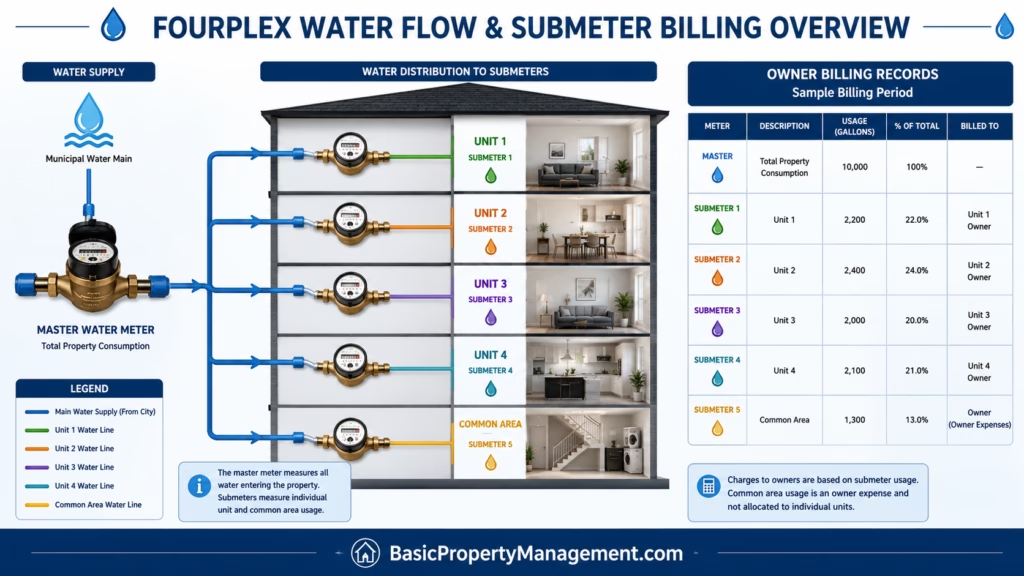
Start by identifying how every utility enters and serves the property. Determine whether electricity, gas, water, sewer, trash, heating, and hot water are separately metered, submetered, master-metered, shared, included in rent, or allocated through a ratio utility billing system.
Do not assume that separate unit numbers mean separate utility systems. A converted duplex may have two electrical panels but one meter. A fourplex may have individual electric meters but one water meter.
EPA guidance on metering and submetering explains how measuring usage can help owners identify consumption patterns and target problems. However, installing a submeter does not automatically authorize any billing method you choose. Your lease and applicable law must support the arrangement.
Small Multifamily Billing Is Not Single-Family Billing
| Utility issue | Single-family rental | Duplex, triplex, or fourplex |
|---|---|---|
| Electricity | Usually one tenant account | Unit meters may coexist with an owner meter |
| Water and sewer | One household’s direct bill | Often master-metered or shared |
| Laundry | Tenant appliances and utilities | Shared machines may use owner-paid service |
| Heating and hot water | Usually dedicated | Central systems may serve several units |
| Vacancy | Service transfers to the owner | Building-wide service often remains active |
| Leak detection | One household’s usage | One leak can hide inside a master bill |
A small multifamily property needs both unit-level records and building-level oversight.
Mistake 1: Charging One Tenant for Shared Usage
A serious problem occurs when a meter assigned to one tenant also serves another unit or a common area.
Unit 1’s electric account might power basement laundry, exterior lights, or a shared garage. That tenant is then paying for services used by the entire property.
Before transferring service, verify what each meter serves. Label panels, breakers, shutoffs, meters, and shared equipment. For an older conversion, consider having an electrician or plumber trace the system.
Do not rely on an informal arrangement such as asking another tenant to reimburse the account holder. It is difficult to audit and may not comply with local requirements.
Mistake 2: Dividing a Master Bill Without a Defensible Formula
When a building has one master meter, dividing the bill equally may appear simple. It becomes harder to justify when units differ in size or occupancy.
A ratio utility billing system, commonly called RUBS, allocates a master bill using a formula based on factors such as occupants, square footage, bedrooms, or fixtures. RUBS estimates usage; submeters attempt to measure it.
Your lease should identify the method, utilities included, calculation process, billing frequency, and permitted fees. Texas provides a useful example: its water and sewer allocation rules require specific disclosures and billing procedures for covered properties. Your jurisdiction may differ, but vague language such as “tenant pays utilities” is not enough.
Mistake 3: Passing Through Common-Area Consumption
Common usage may include hallway lights, laundry rooms, irrigation, exterior outlets, parking lights, and vacant-unit work.
If unit submeters do not add up to the master bill, the difference may represent common-area use, leaks, or meter variation. Do not automatically divide that difference among tenants. Some jurisdictions require the owner to absorb common consumption, while others permit limited allocation under specific conditions.
A separate owner meter can simplify shared electrical service. Where separate water infrastructure is impractical, you may need a compliant allocation method or include part of the cost in rent.
Mistake 4: Using Lease Terms That Do Not Match the Property
A template stating that the tenant pays “all utilities” may not describe how a small multifamily building operates.
The lease should identify:
- Utilities placed in the tenant’s name
- Utilities billed by the landlord
- Utilities included in rent
- The submetering or allocation method
- Billing frequency and due dates
- Permitted administrative charges
- Treatment of common-area and vacant-unit usage
- The procedure for reviewing or disputing a charge
The listing, application, approval notice, and lease should describe the same arrangement. If the advertisement says water is included, the tenant should not later receive an unexpected allocation bill.
A Fourplex Billing Example
Assume a fourplex receives a $620 master water bill. The four units have one, two, two, and four occupants.
An equal split produces $155 per unit. An occupancy-based allocation produces:
| Unit | Occupants | Allocated amount |
| Unit 1 | 1 | $68.89 |
| Unit 2 | 2 | $137.78 |
| Unit 3 | 2 | $137.78 |
| Unit 4 | 4 | $275.56 |
The occupancy method may appear more responsive to usage, but it is not automatically lawful or accurate. Common-area water, irrigation, vacancies, provider fees, and local rules may require adjustments.
The important point is that your calculation must be written, repeatable, and supported by records.
Mistake 5: Ignoring Vacancies and Turnover Work
Vacancy can distort a master-meter allocation.
Suppose one unit in a triplex is vacant while contractors use water for cleaning and repairs. Dividing the full bill between the two occupied tenants may shift owner-related consumption to them.
Your process should account for occupancy dates, contractor use, vacant-unit leaks, common-area consumption, and move-in or move-out timing. The owner may need to absorb the vacant share. Decide how it will be handled before the vacancy occurs.
Mistake 6: Passing Through a High Bill Before Checking for Leaks
A high bill may indicate a maintenance problem rather than higher tenant consumption.
A running toilet, irrigation leak, failed valve, or hidden pipe can increase a building-wide bill without producing an obvious complaint. EPA guidance on leak detection and repair recommends tracking usage and investigating unexplained changes.
Create a variance process. When usage rises beyond a defined amount:
- Compare consumption, not only the cost.
- Check for rate and occupancy changes.
- Inspect fixtures, water heaters, irrigation, and vacant units.
- Compare submeter readings where available.
- Document the cause and repair.
Do not pass an unexplained spike directly to tenants. If owner-deferred maintenance caused the increase, billing tenants may create legal and relationship problems.
Mistake 7: Combining Utility Reimbursements With Rent
Utility charges should be recorded separately from base rent.
If a tenant owes $1,500 in rent and $110 for water, the ledger should show both entries. Combining them into one $1,610 charge makes it harder to track rent, late fees, management charges, and utility recovery.
Your records should show the master cost, amount billed to each unit, amount collected, owner-paid share, credits, corrections, and outstanding balances. Full recovery should not be assumed because common-area and vacancy costs may remain your responsibility.
Mistake 8: Billing Late or for the Wrong Period
Each tenant bill should identify the utility, service dates, calculation basis, tenant share, fees, credits, issue date, due date, and dispute procedure.
Billing rules can be specific. Virginia law permits certain submetering and RUBS arrangements when the rental agreement provides for them, while related regulations address billing periods. The state’s utility allocation statute illustrates why the lease and billing cycle must be coordinated.
Even where local law is less detailed, regular billing reduces confusion and makes calculations easier to audit.
Mistake 9: Leaving a Billing Company Unchecked
A third-party company can handle readings, allocation, statements, and tenant questions, but you still need oversight.
Confirm how it handles vacancies, common usage, meter testing, fees, billing disputes, corrections, and access to records. Review sample bills before implementation and make sure you retain the data if the service agreement ends.
Outsourcing the calculations does not replace accurate lease language or owner responsibility.
Keep a Permanent Utility File
Maintain one file containing meter locations, photographs, serial numbers, account details, a diagram of shared systems, lease clauses, formulas, occupancy records, master bills, tenant statements, readings, credits, and leak repairs.
This documentation becomes valuable when you change managers, sell the building, replace meters, or respond to a dispute.
Also evaluate whether separate metering is worth the installation, permit, maintenance, and billing costs. Compare the investment with realistic annual savings, not the full utility bill. Common-area and vacancy usage may remain an owner expense after the retrofit.
Match the Billing Method to the Building
Rental property utility billing mistakes usually begin when you apply a single-family assumption to a shared building.
A duplex, triplex, or fourplex may have master meters, common systems, changing occupancy, and costs that cannot be assigned neatly to one household. Map the system first, use lease language that matches it, and apply a calculation you can reproduce.
Investigate unusual bills before passing them through. Separate utility charges from rent and preserve the records behind every statement.
The goal is not to recover the largest possible amount. It is to create a billing process that is accurate, transparent, compliant, and understandable.