Is a Cost Segregation Study for Rental Property Worth It?
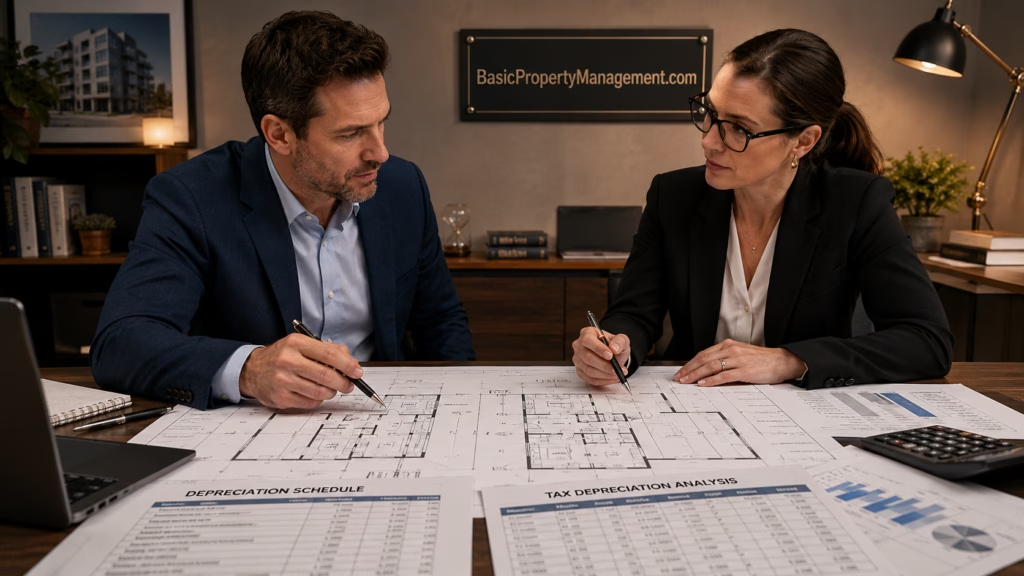
A large depreciation deduction can make a cost segregation study look like an obvious decision. The real question, however, is not how much depreciation the study identifies. It is how much of that deduction you can use, when you can use it, and what the accelerated depreciation may cost you later.
A cost segregation study for rental property separates eligible building components from the structure and assigns them shorter depreciation periods. Instead of depreciating nearly everything with the residential or commercial building, you may be able to recover certain costs much sooner.
That accelerated depreciation can reduce near-term taxable income and leave more cash available for debt service, renovations, reserves, or another acquisition. But the strategy is not equally valuable for every owner. Passive-loss limitations, the study fee, your holding period, and depreciation recapture can materially change the result.
Learn How Successful Landlords Manage Better Rentals
Join our 2X weekly newsletter for clear, actionable guidance on property management, leasing, tenant issues, rental property operations, and real estate investing strategies you can actually use.
What a Cost Segregation Study Changes
Without cost segregation, residential rental buildings are generally depreciated over 27.5 years, while nonresidential real property is generally depreciated over 39 years. Land is not depreciable.
A study examines the property and allocates eligible costs among categories such as the building, land improvements, equipment, furniture, fixtures, and other personal property. Certain components may qualify for shorter five-, seven-, or 15-year recovery periods rather than remaining part of the longer-lived building.
Examples may include some flooring, specialty electrical work, cabinetry, appliances, landscaping, parking improvements, fencing, and dedicated building systems. Classification depends on the asset’s function, installation, and applicable tax authority—not merely what the component is called.
The IRS Cost Segregation Audit Technique Guide explains that a study should classify the assets, support the legal basis for each classification, substantiate the allocated costs, and reconcile those amounts to the property’s actual total cost.
The benefit comes from timing
Cost segregation generally does not create a new depreciable basis. It changes when you recover portions of the basis you already have.
Consider a simplified example. You purchase a rental property and allocate $1 million of the acquisition basis to the depreciable building and improvements after separating the land value. A study identifies $200,000 of qualifying shorter-life property.
You have not generated an additional $200,000 investment cost. You have changed the depreciation schedule for that portion of the original basis. The potential value comes from claiming deductions sooner rather than waiting years to recover them through regular building depreciation.
Receiving the tax benefit earlier can improve your after-tax cash flow. Whether that improvement is meaningful depends on your tax rate and your ability to use the deduction.
Current Bonus Depreciation Raises the Stakes
Cost segregation can become particularly valuable when shorter-life components qualify for bonus depreciation.
Current federal rules provide permanent 100% additional first-year depreciation for eligible property acquired after January 19, 2025. Qualified property generally includes eligible depreciable property with a recovery period of 20 years or less, subject to the detailed acquisition, use, and placed-in-service requirements.
That means many assets identified through a cost segregation study for rental property may qualify for immediate depreciation rather than merely moving from a 27.5- or 39-year schedule to a five-, seven-, or 15-year schedule.
The IRS bonus depreciation guidance also describes elections that may affect how the deduction is claimed. You should coordinate these decisions with your tax adviser rather than assume the maximum immediate deduction is always the best choice.
The placed-in-service date matters
Depreciation begins when the property is ready and available for its intended use, not necessarily when you close on it or pay for the study.
A vacant property undergoing a major renovation may not yet be placed in service as a rental. Similarly, components installed during a later renovation may have a different placed-in-service date from the original building.
Confirm the applicable dates before relying on projected deductions in your acquisition or renovation budget.
Run Three Tests Before Ordering a Study
The headline depreciation number is only the beginning. You need to test the strategy against your own tax position and investment plan.
1. Can you use the accelerated loss?
Rental real estate is generally treated as a passive activity. The passive-activity and at-risk rules can limit the amount of a rental loss you may deduct in the current year.
Your losses may be suspended rather than permanently lost, but a suspended deduction does not create an immediate cash-flow benefit. Your circumstances may differ if you qualify under the real estate professional rules, have other passive income, actively participate and qualify for a special allowance, or operate a property that receives different tax treatment.
The IRS passive activity rules explain how these limitations can affect rental and other income-producing activities. Your CPA should estimate the usable deduction before you approve the study.
Ask for two projections:
- The additional depreciation the study may generate
- The amount you are likely to deduct in the current tax year
Those numbers may be very different.
2. Is earlier depreciation valuable to you?
Accelerating a deduction generally produces tax deferral rather than a permanent elimination of tax.
Tax deferral can still be valuable. You retain cash today and may use it to reduce expensive debt, fund capital improvements, maintain reserves, or acquire another property. The longer and more productively you can use that cash, the more valuable the timing benefit may become.
But the analysis changes if you have limited taxable income, substantial suspended passive losses, or plans to sell the property soon. In those situations, the immediate benefit may not justify the cost and complexity of the study.
3. Does the projected benefit exceed the total cost?
Compare more than the provider’s fee. Include the cost of tax-return implementation, possible Form 3115 preparation, ongoing fixed-asset tracking, and additional work when assets are replaced or the property is sold.
A useful estimate should show:
- Additional first-year and near-term depreciation
- Estimated current-year tax savings
- The study and tax-preparation costs
- The expected holding period
- Potential suspended losses
- Estimated consequences at disposition
Do not choose a study solely because the provider promises a large reclassification percentage. The better question is how the projected after-tax benefit compares with the total implementation cost.
Which Properties Are Stronger Candidates?
A study tends to deserve closer consideration when you have a substantial depreciable basis, meaningful site improvements or specialized components, sufficient taxable or passive income, and a multi-year holding plan.
Potential candidates include apartment properties, short-term rentals, mixed-use buildings, office properties, retail space, industrial facilities, self-storage properties, and heavily improved residential investments. Renovations and new construction may also provide detailed cost records that support asset allocation.
A study may be less compelling when the depreciable basis is modest, most of the purchase price is allocated to land, you cannot currently use the deductions, or you expect to dispose of the property shortly.
There is no universal minimum property value that makes a study worthwhile. Study pricing, asset complexity, tax rates, ownership structure, and usable losses differ too much for a single threshold to be reliable.
What a Defensible Study Should Include
Cost segregation is more than a spreadsheet applying percentages to the purchase price.
The IRS describes a quality study as accurate and well documented. Its guidance emphasizes preparer expertise, a detailed methodology, supporting records, legal analysis, cost reconciliation, asset descriptions, and consideration of related accounting-method issues.
Before hiring a provider, ask:
Who performs the analysis?
Determine whether qualified tax, engineering, construction, or valuation professionals participate. Ask about experience with your property type and who will respond if the study is examined.
How are costs established?
For new construction, the provider may use contracts, invoices, drawings, change orders, and contractor records. For an acquired property with incomplete records, the provider may need a detailed engineering cost estimate.
The study should explain how the costs were determined and reconcile the allocations to your depreciable basis.
What documentation will you receive?
You should receive more than a one-page summary. The report should identify the assets, assigned costs, recovery periods, methodology, supporting tax rationale, and total reconciliation.
Keep the report with your closing documents, depreciation schedules, renovation records, and tax returns. You may need these records when replacing components, responding to an examination, refinancing, or selling.
You May Not Be Too Late on an Older Property
You do not always have to complete the study during the year you acquire the property.
A look-back study may identify depreciation that should have been claimed in earlier years. Depending on the circumstances, correcting the treatment may require Form 3115 and a Section 481(a) adjustment rather than amended returns.
The adjustment can account for the difference between depreciation previously claimed and the amount that should have been claimed under the corrected method. This is a technical accounting-method issue, so your study provider and tax professional need to coordinate before implementation.
An older acquisition may therefore remain a candidate, particularly when you still plan to hold the property and have income against which the additional deduction can be used.
Account for the Tax Consequences When You Sell
Accelerated depreciation reduces your adjusted tax basis. When you later sell depreciable property at a gain, some of the gain may be treated as ordinary income under the depreciation recapture rules rather than receiving capital-gain treatment.
Cost segregation can also create several asset categories that must be addressed separately when allocating the sale price. Section 1245 property and Section 1250 property can receive different tax treatment. Even a like-kind exchange may not eliminate every recapture issue in all circumstances.
This does not automatically make the study a bad strategy. It means you should compare the current tax savings with the estimated future tax cost.
Your projection should account for:
- How long you expect to own the property
- Your current and expected future tax rates
- The likely sale or exchange strategy
- The projected adjusted basis at disposition
- Potential Section 1245 and Section 1250 treatment
A provider who discusses only first-year savings is giving you an incomplete analysis.
Make the Decision From Usable Tax Savings
A cost segregation study for rental property can improve near-term cash flow, but the study itself does not guarantee a usable tax benefit. The result depends on the property, the quality of the report, your tax position, and what you eventually do with the asset.
Before ordering a study, ask your tax adviser to model the deduction under your actual passive-loss, at-risk, ownership, and income circumstances. Then compare the usable tax savings with the study cost and future recapture exposure.
When those numbers work, cost segregation can be a practical capital-management tool. When they do not, an impressive depreciation estimate may produce little immediate value.
The objective is not to claim the largest possible deduction on paper. It is to improve your investment’s after-tax cash flow without creating compliance problems or overlooking the cost that may arise when you sell.