Is There Hidden NOI in Your Multifamily Property?
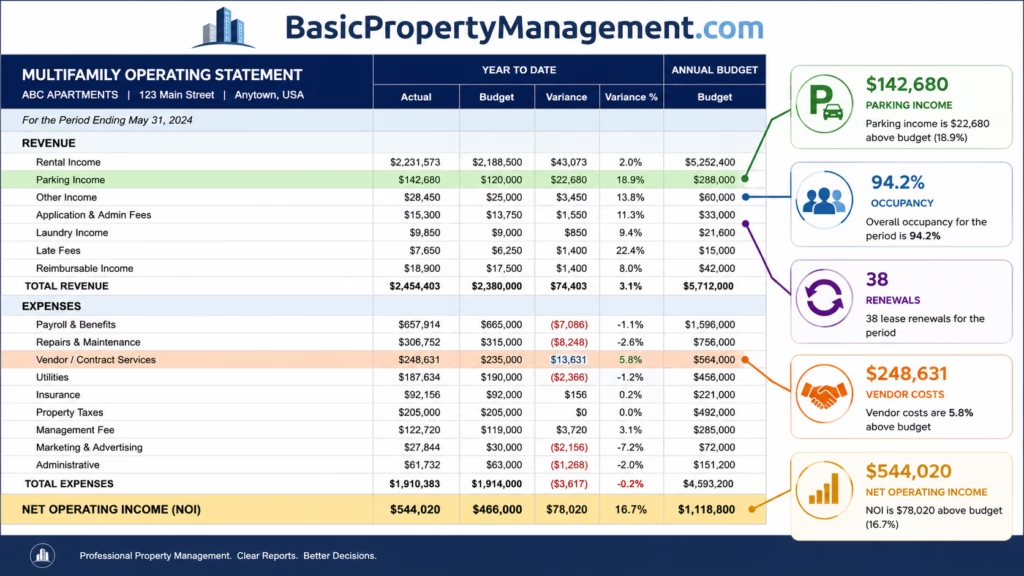
Your property may not need a major renovation or a large rent increase to produce more income. The next improvement could already be sitting in your monthly financials: an unnecessary vendor charge, empty parking spaces, slow unit turns, weak collections, or renewal pricing that nobody has reviewed closely.
If you want to know how to increase NOI in multifamily properties, start asking more questions about the numbers you already have.
Get Actionable Property Management Tips Twice a Week
Want smarter systems for managing rentals, screening tenants, handling maintenance, and improving property performance? Sign up for our 2X weekly newsletter and get practical property management and real estate investing insights delivered straight to your inbox.
Start With the Questions Behind the Numbers
Many owners look at a monthly income statement primarily to see whether the property met budget.
That is useful, but it only tells you what happened. It does not tell you whether the property could have performed better.
A more useful review starts with questions such as:
Why did this expense increase?
Why are we still paying this vendor?
Why did repairs increase when work-order volume did not?
Why are several preferred parking spaces producing no income?
Why did bad debt rise while occupancy stayed relatively stable?
Why are renewal increases below what we expected?
Why does one similar property spend less per unit on the same service?
You do not need to assume that every variance represents a problem. Insurance may have increased because the market changed. A repair account may be high because you replaced several failed water heaters. Payroll could be up because you finally filled an open maintenance position.
The point is to understand the reason.
Once you know why a number changed, you can decide whether there is anything worth fixing.
Set Aside 30 Minutes for a Monthly NOI Review
Do not turn this into another long management meeting.
Set aside a short monthly review specifically for revenue and expense opportunities. Pull together:
- Current-month income statement
- Budget-to-actual report
- Prior-year comparison
- Trailing 12-month operating statement
- Current rent roll
- Vacancy and turnover report
- Delinquency report
Property management software can produce most of these reports. A basic spreadsheet is often enough to bring the key figures together.
Your review sheet does not need to reproduce the entire financial statement. Pull out the accounts that deserve attention and record what you need to investigate:
| Item | What Changed | Question | Next Step |
|---|---|---|---|
| Trash | $650 over budget | What caused the increase? | Check invoices |
| Parking | $400 below budget | Are spaces sitting unused? | Audit spaces |
| Bad debt | $2,300 over budget | Which balances increased? | Review accounts |
| Repairs | $1,900 over budget | More work or higher costs? | Check work orders |
Do not waste time investigating every small variance. Focus on amounts that are large, recurring, unusual, or moving steadily in the wrong direction.
IREM’s discussion of property income and expense benchmarking makes a similar point: comparing financial performance with benchmarks can help managers spot deviations, look for the cause, and decide where corrective action makes sense.
Compare costs in ways that make sense
Dollar totals alone can fool you.
A $7,000 monthly maintenance expense may be reasonable for a 100-unit property and alarming for a 30-unit property.
Look at important accounts in several ways:
- Cost per unit
- Cost per occupied unit
- Cost per turnover
- Cost per work order
- Percentage of collected income
- Current year versus prior year
- Property versus similar properties
The comparison does not give you the answer. It tells you where to ask the next question.
Ask Five Questions About Recurring Expenses
Recurring expenses deserve special attention because a small monthly leak can continue for years.
Operating costs have also become harder to ignore. The National Apartment Association reported that repairs and maintenance costs rose nearly 28% from 2021 through 2024 while NOI increased about 10% over the same period. Its review of elevated apartment operating costs also points to continued pressure from turnover and leasing costs.
Some increases are outside your control. Others deserve a closer look.
For each meaningful recurring vendor or service expense, ask five questions.
Do we still need this?
Properties sometimes continue paying for a service long after the original need disappeared.
Maybe you added a temporary security patrol after a problem several years ago. Perhaps an old technology contract survived after the property moved to another system.
Check what you are actually receiving.
Are we paying for the same thing twice?
Review overlapping contracts and invoice descriptions.
Landscaping, pest control, maintenance, trash, internet, security, software, and administrative services can occasionally overlap without anyone noticing.
Has the price crept up?
A $75 monthly increase barely attracts attention.
Three years later, however, the same contract may cost hundreds more per month than it did when you originally bid the work.
Ask when the service was last priced against alternatives.
Are we paying for the right level of service?
More is not always better.
A property paying for three trash pickups each week may only need two. Another community may need an additional pickup because repeated overflow charges now cost more than increasing the regular schedule.
Look at actual use rather than the original contract.
Does the invoice match the work?
Go beyond the general ledger.
If repairs increased $2,000, review the invoices and work orders. Determine whether you had more calls, repeat repairs, higher material prices, or one unusual job.
“Maintenance was high this month” is not enough.
You want to know what made it high.
Look for Incremental Revenue Before Raising Base Rent
When owners talk about increasing revenue, rent increases usually dominate the conversation.
They should not.
Depending on the property and applicable rules, other income might come from:
- Reserved parking
- Garages
- Storage
- Pet rent
- Laundry
- Utility reimbursements
- Furnished-unit premiums
- Premium unit locations
- Better collection of existing charges
The objective is not to invent fees simply because residents have limited alternatives. Look for services, conveniences, or legitimate cost recoveries that residents actually use.
Count what the property already has
Consider preferred parking.
A 64-unit property has 12 spaces close to the building entrances. Residents already compete for them, but the spaces are unassigned.
Charging $45 per month would produce:
12 spaces × $45 × 12 months = $6,480 per year
That does not mean you should immediately add $6,480 to next year’s NOI.
First, find out whether residents will pay for the spaces. Check whether local rules or current leases create any restrictions. You also need to estimate how many spaces will remain rented consistently.
The opportunity becomes real when the income starts appearing on the monthly statement.
Find Out Why Units Stay Vacant Too Long
Occupancy problems often show up as a percentage, but a percentage does not tell you what went wrong.
Suppose a 64-unit property averages $1,450 per month in rent. Increasing average occupancy from 60 units to 62 units could produce as much as $34,800 in additional annual gross rent before considering concessions, collection losses, and added costs.
That number is worth investigating.
Do not stop at “we need higher occupancy.”
Track what happens to each vacant unit:
Notice received → move-out → make-ready → available → application → approval → move-in
Now look for delays.
If an average unit takes 14 days to make ready, determine why. Materials may not be ordered until after move-out. Vendors could be difficult to schedule. Maintenance may be covering too many work orders at the same time.
A different problem exists when units become ready quickly but remain vacant.
In that case, review:
- Asking rent
- Lead volume
- Response time
- Showing activity
- Application conversion
- Concessions
- Competing properties
- Unit condition
Fannie Mae’s multifamily underwriting guidance similarly looks at market rents, occupancy, and operating expenses in relation to comparable multifamily properties.
Your occupancy rate tells you there is a problem.
The timeline tells you where the problem is.
Renewal Pricing Has a Turnover Cost
A renewal increase looks straightforward on paper.
Suppose 30 residents are scheduled to renew during the next year. An additional $40 per month would equal:
30 × $40 × 12 = $14,400
That is the upside if everyone renews.
Now consider the cost when a resident leaves.
You may lose rent while the unit is vacant and pay for cleaning, painting, repairs, advertising, concessions, staff time, and possibly outside leasing costs.
The best renewal increase is therefore not always the highest increase the market might tolerate.
Review:
- Current rent
- Comparable new-lease rent
- Renewal acceptance rate
- Average days vacant after turnover
- Make-ready cost
- Concessions
- Resident payment history
- Planned renovations
- Nearby competing supply
A $30 increase with strong retention may produce more NOI than a $70 increase that pushes several good residents out.
Do the math both ways.
Full Occupancy Does Not Mean Full Collections
A rented unit only helps NOI when the rent is collected.
That makes economic occupancy just as important as physical occupancy.
Review:
- Current delinquency
- 30-day balances
- 60-day balances
- 90-day balances
- Bad debt
- Payment plans
- Uncollected resident charges
- Former-resident balances
Next, look for patterns.
Are most balances concentrated among a few residents? Do small charges repeatedly sit unpaid until move-out? Has follow-up become inconsistent? Are payment plans being made without anyone checking whether residents keep them?
“Improve collections” is too vague to manage.
A useful action might be:
Send balance reminders five days earlier.
Or:
Review every payment-plan account each Friday.
Maybe the problem is former-resident balances that never move to the next collection step.
Fix the specific breakdown and watch what happens to cash collections over the following months.
Benchmark the Outlier, Then Explain It
Benchmarks are useful because they show you where your property looks different.
They are not instructions to cut an expense.
Suppose water costs $780 per unit at your property and similar buildings appear to spend much less.
Investigate the difference.
Your property could have:
- Older plumbing
- Master-metered utilities
- Irrigation
- A swimming pool
- Higher local utility rates
- Undetected leaks
- Different resident usage
The same applies to payroll, repairs, turnover, insurance, landscaping, and contract services.
A high number may be justified. A low number can also be a warning sign if the property is under-maintained or understaffed.
Use benchmarks to find the outlier.
Then figure out why the outlier exists.
Track Each Idea Until It Shows Up in the Numbers
One of the easiest ways to lose an NOI opportunity is to discuss it in a meeting and never check it again.
Someone agrees to call the trash company. Another person says they will look into parking. The manager plans to review collections.
A month later, nobody remembers what changed.
Your review sheet does not need to reproduce the entire financial statement. Pull out the accounts that deserve attention and record what you need to investigate:
| Opportunity | Annual Potential | Next Step | Result |
|---|---|---|---|
| Cancel unused service | $2,880 | Review contract | Pending |
| Reserved parking | $6,480 | Test demand | Pending |
| Improve collections | $3,000 | Change follow-up | Pending |
| Faster turns | $5,800 | Pre-order materials | Pending |
| Renewal pricing | $7,500 | Review leases | Pending |
In your working version, add columns for the person responsible and the target date. Keeping them out of the example above makes the process easier to see without turning the table into a miniature spreadsheet.
Keep “possible” and “actual” separate.
If a vendor agrees to cut a charge by $200 per month, confirm that the next invoice actually falls by $200.
Parking does not produce $6,480 because ten people said they liked the idea. It produces income when residents begin paying for spaces.
Your monthly financials should eventually confirm the result.
A 64-Unit Example Shows How Small Gains Add Up
Consider a fictional 64-unit apartment property.
Occupancy is stable. Rents are reasonably close to market. Nothing in the monthly reports suggests a major operating problem.
A closer review uncovers five smaller issues.
An old vendor charge
The property still pays $240 per month for a service management rarely uses.
Possible annual savings: $2,880
Preferred parking with no charge
Ten spaces near the entrances are regularly in demand. After checking resident interest, management believes $45 per month is reasonable.
Possible annual revenue: $5,400
Slow unit turns
Twelve ordinary turns each year lose roughly 10 days that could potentially be avoided through better scheduling.
At $1,450 monthly rent, 120 recovered rental days could represent about:
$5,800 in additional gross rent
Collections that need better follow-up
Management finds that a tighter collection schedule could reduce write-offs by an average of about $250 per month.
Possible annual improvement: $3,000
Renewal pricing that has not kept pace
Twenty-five upcoming renewals appear to support an average additional $25 per month without changing the overall retention strategy.
Possible annual rent: $7,500
Together, those items total approximately $24,580.
Do not add the full amount to your forecast yet.
Implement each change. Track what residents actually pay, how many vacancy days you recover, whether the vendor savings appear, and whether collections improve.
Some estimates will prove too optimistic.
Others may lead you to a larger opportunity than you expected.
Connect Better NOI to the Investment Analysis
Improving NOI is not only an operating issue. It can also affect how you look at the property’s value and investment performance.
Assume the 64-unit property eventually produces a verified, recurring $24,000 increase in annual NOI.
At a 6% capitalization rate, a simple direct-cap calculation would be:
$24,000 ÷ 0.06 = $400,000
That does not mean the property automatically gains exactly $400,000 in market value. Buyers may apply a different cap rate, and they may view certain income sources or expense reductions differently.
The example shows why recurring operating improvements can matter beyond this month’s cash flow.
This is also where the property-management work connects directly with investment analysis.
Our Investment Real Estate Analysis: A Case Study ebook takes the reader through the broader process of evaluating an income-producing property, including the income and expense assumptions, financing, projected performance, and information behind an investment decision.
The process in this article works from the operating side of that same equation.
You are asking: Can this property actually produce more NOI than the current financials show?
Investment analysis asks the next questions: What does that income mean for value, cash flow, financing, and the return you expect from the property?
If you improve NOI without understanding its effect on the overall investment, you only have half the picture.
Do Not Improve NOI by Playing With the Accounting
A better NOI should come from better property performance.
Moving a recurring operating expense somewhere else on the income statement does not save money.
For example, suppose you negotiate the landscaping contract from $3,000 per month to $2,600 while keeping the same service level.
You saved $4,800 annually.
That is a real improvement.
If you simply move part of the landscaping cost below the NOI line, the property itself did not improve at all.
The same principle applies to repairs, payroll, administrative expenses, and other recurring costs.
Keep the analysis clean enough that another investor could understand what the property actually costs to run.
Include the Property Manager in the Review
The property manager often knows what happened before the owner sees it in the financials.
Use that knowledge.
Suppose trash expense increased $650.
The conversation might go like this:
Owner: Trash was high again. What happened?
Manager: We had three overflow charges.
Owner: Were they related to normal use or something unusual?
Manager: Two happened during heavy move-outs.
Owner: Does that happen regularly during turnover?
Manager: A few times each year.
Owner: Would arranging a temporary bulk pickup during those weeks cost less?
Now you have a question worth answering.
Compare that with:
Owner: Trash is over budget. Please lower it.
The second version gives the manager a target without explaining the problem.
Bring the people closest to the property into the discussion. Maintenance may understand why repair costs increased. Leasing can explain lost prospects and renewal objections. Accounting can spot an invoice issue that operations missed.
The financial statement tells you where to look.
Your team often tells you why it happened.
Use a 5-3-2-1 Monthly NOI Review
A useful monthly review does not need to cover every account.
Try a simple 5-3-2-1 format.
Five variances
Choose the five largest or most unusual changes in revenue or expenses.
Ask what caused each one.
Three open opportunities
Review the three most important items already on the opportunity list.
Check what has actually happened since the last meeting.
Two operating measures
Rotate through figures such as:
- Occupancy
- Collections
- Renewals
- Make-ready days
- Concessions
- Work-order volume
Pick the two that deserve attention that month.
One new idea
Choose one new revenue or expense idea to investigate before the next review.
That is enough.
You are trying to create a habit of looking closely at the property, not another reporting exercise that everyone dreads.
Give Yourself 90 Days to Find the First Wins
If you have never reviewed a property this way, use the first three months to build the habit.
Month 1: Find the questions
Review the prior 12 months.
Look for unusual vendor costs, missed income, recurring delinquency, long unit turns, weak renewal results, and unexplained variances.
Write down the questions before deciding on the answers.
Month 2: Try the best ideas
Choose a small number of opportunities with a reasonable payoff and limited downside.
Get another vendor quote. Test demand for reserved parking. Pre-order turn materials. Change the collection follow-up schedule.
Give each task to one person.
Month 3: Check the results
Go back to the numbers.
Did the invoice decrease?
How many parking spaces rented?
Are units becoming ready sooner?
Did bad debt fall?
What happened to renewal acceptance?
Do not take credit for a saving until you can see it.
After 90 days, you should have a much clearer idea of which changes made a difference and which sounded better in the meeting than they worked in practice.
What Will You Find Next Month?
Learning how to increase NOI in multifamily properties rarely comes down to finding one enormous mistake.
More often, you find $200 here, $500 there, a few unnecessary vacancy days, one vendor contract that needs attention, or income from something residents already value.
Individually, those amounts may not look important.
Together, they can change the performance of the property.
Keep asking why an expense changed. Look at the units that stayed vacant longer than expected. Check whether residents are paying what the rent roll says they owe. Review the services you pay for and the amenities you give away.
Then make one change and see whether it works.
Next month, do it again.