
Why AI May Reshape Office Demand More Than It Reduces It
Artificial intelligence is often discussed as if every productivity gain will remove an employee, an office, and a row of desks. That may happen in some industries and job functions, but it is too simple to use as a broad forecast for office demand.
The more immediate issue for investors is that companies expect AI to change how work is performed before they know how their real estate should respond.
The JLL Future of Work Survey 2026 found that 78% of business and corporate real estate leaders expect AI to significantly affect portfolio strategy during the next three to five years. However, only 31% are actively preparing to redesign space for human-AI collaboration, and just 15% have reached the optimization stage of AI adoption. The research included more than 2,200 executives and CRE leaders across 21 countries.
That gap between expectation and action is where the investment question becomes more complicated. Companies may not need less office space. They may need different office space, and many existing buildings may not be ready to provide it.
Build a Stronger Rental Property Business
Subscribe to our 2X weekly newsletter to learn more about managing tenants, protecting cash flow, improving rental operations, and making better real estate investment decisions.
The Market May Be Asking the Wrong Question
The usual debate begins with a simple assumption: if AI automates office jobs, companies will lease fewer square feet.
That scenario cannot be dismissed, particularly in buildings dependent on administrative, processing, support, and other highly repeatable office functions. But the JLL findings do not point to widespread expectations of immediate workforce contraction.
Approximately three out of five respondents expect their workforces to expand. A similar share expects human roles to be enhanced by AI rather than eliminated by it. Respondents also favored full-time employment over a broader move toward flexible employment models.
For an investor, this changes the analysis. You should not assume that AI adoption creates a direct one-for-one reduction in employee headcount or occupied space.
AI may automate parts of a job while allowing the same employee to handle more complex work. It may also create new positions in data management, cybersecurity, AI oversight, systems integration, compliance, training, and product development. Some companies may reduce staff in one department while expanding another.
The outcome will vary by tenant, industry, and location. Office demand will reflect that variation.
Headcount Does Not Translate Directly Into Square Footage
Even when a company adds employees, its footprint may not grow at the same rate. Hybrid schedules, shared desks, higher occupancy targets, and more efficient space planning have weakened the old relationship between headcount and leased area.
The opposite can also occur. A company may keep its headcount relatively stable while allocating more space to meeting rooms, training areas, project teams, secure collaboration, client interaction, and individual focus work.
You therefore need to evaluate both the number of workers and the type of work they will perform. A tenant with 500 AI-assisted employees may have very different space needs from a traditional 500-person office tenant.
AI Changes the Definition of a Competitive Office
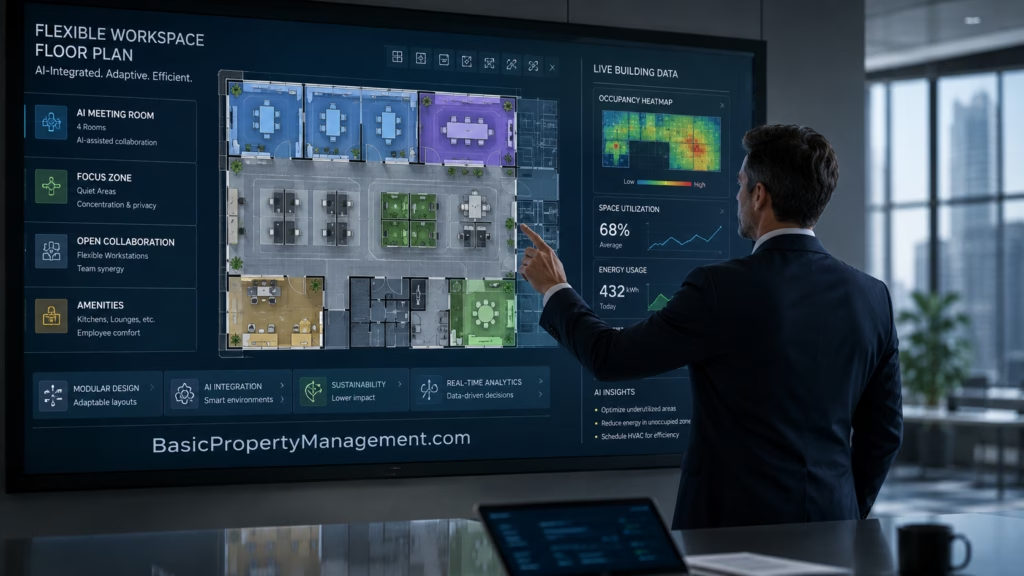
The strongest office buildings will not necessarily be those with the greatest number of desks. They will be the buildings that allow tenants to change workflows, team structures, and technology without repeatedly rebuilding the premises.
JLL’s AI-era workplace research identifies a shift toward smaller project teams, more fluid job responsibilities, intensive collaboration, specialized workstations, and closer interaction between employees and AI systems. It also points to demand for secure partnership areas where companies can work with vendors, universities, consultants, and outside specialists.
For investors, several building characteristics become more important.
Flexible Layouts Become a Form of Risk Control
AI development cycles can move much faster than commercial lease terms. A tenant may sign a seven- or ten-year lease while its staffing model changes several times during that period.
Buildings that can be reconfigured without major structural work give tenants more room to adapt. Useful features may include:
- Regular floor plates with limited structural obstructions
- Demountable partitions and modular meeting rooms
- Raised floors or accessible service distribution
- A mix of private, collaborative, and shared spaces
- Expansion and contraction options within the property
- Prebuilt suites that can be occupied quickly
These features do not guarantee leasing demand, but they reduce the cost and disruption associated with changing space requirements.
Technology Infrastructure Moves Up the Leasing Checklist
Tenants will increasingly examine whether a building can support dependable connectivity, secure networks, advanced conferencing, sensor systems, occupancy monitoring, and other data-intensive tools.
This does not mean every office building needs the power and cooling capacity of a data center. It does mean that unreliable internet service, weak wireless coverage, outdated electrical systems, and limited technology redundancy may become more serious leasing disadvantages.
Cybersecurity and data privacy were identified by 47% of JLL respondents as major portfolio risks. Technology or AI disruption was cited by 41%, while 40% pointed to uncertainty about AI’s effect on space requirements.
As part of your due diligence, you should understand which technology systems are controlled by the landlord, which are controlled by the tenant, and how building-generated data is collected and protected.
Physical Comfort Still Matters
One risk is assuming that technology can compensate for a poorly designed workplace.
JLL found that companies are prioritizing AI support and reliable technology infrastructure, but the report also warns that acoustics, lighting, thermal comfort, movement, and quiet focus areas remain essential to employee performance.
A technology-ready building with distracting noise, poor ventilation, uncomfortable temperatures, or inadequate meeting space may still struggle to retain tenants. The office must support both digital tools and human concentration.
Office Demand Could Split More Sharply by Building Quality
AI and office demand should not be viewed as a single national trend. The effects are more likely to appear through stronger separation between buildings that meet modern tenant requirements and those that do not.
Recent leasing data already shows that the office market is not moving uniformly. According to Cushman & Wakefield’s Q2 2026 office market data, the four-quarter rolling absorption total reached positive 14.3 million square feet, its strongest level since 2020 and the seventh consecutive quarter of improvement. At the same time, obsolete inventory continued to be removed through conversions, demolitions, and repositioning.
This does not mean that every office property is recovering. It suggests that office demand can improve while weaker buildings continue losing relevance.
You can think about the market in three broad groups.
Adaptable, well-located buildings may benefit from tenants seeking quality, reliable infrastructure, flexible layouts, and strong employee environments.
Functional mid-market buildings may remain competitive when they have a clear and economically reasonable upgrade path.
Obsolete commodity buildings face the greatest risk, especially when they combine weak locations, inefficient layouts, deferred maintenance, limited technology capacity, and high conversion costs.
AI may accelerate this separation because tenants will have another reason to reconsider whether their current space supports the way they expect to work.
How to Underwrite AI and Office Demand
You do not need to predict exactly how AI will affect every job. You do need an underwriting process that recognizes several possible outcomes.
Study the Tenant’s Work, Not Just Its Industry
Two companies in the same industry may use AI differently.
Review which business functions occupy the space, how much of the work is repetitive, whether employees handle sensitive information, and how dependent the company is on training, teamwork, client interaction, or specialized equipment.
A regional processing center may face different automation risks than a research, legal, engineering, design, or client-service office.
Quantify the Cost of Reconfiguration
Determine how easily a tenant can change the layout.
Estimate the cost of adding meeting rooms, quiet areas, secure zones, additional power, improved data connections, and new access controls. Examine whether the work can occur in phases or would require substantial tenant disruption.
A building may appear adaptable until you calculate the actual cost of moving walls, rerouting systems, or upgrading electrical capacity.
Model More Than One Leasing Scenario
Your base case should not rely on a single assumption about AI.
Consider at least three scenarios:
Workforce expansion: AI improves output and supports growth. The tenant adds employees and may require additional or higher-quality space.
Space redesign without major growth: Headcount remains relatively stable, but the tenant shifts space from individual desks toward collaboration, training, focus work, and technology-supported rooms.
Automation-led contraction: The tenant reduces selected job functions, consolidates locations, or subleases excess space.
Assign realistic probabilities to each outcome and test the effect on occupancy, tenant improvement costs, renewal assumptions, downtime, and exit value.
Review the Capital Plan Before Paying for Potential
A building may have the ability to compete after renovation, but that does not mean the investment is financially sound.
Separate essential work from optional improvements. Identify which upgrades can be completed during normal tenant turnover and which require a major repositioning. Include professional fees, permitting, downtime, leasing commissions, tenant allowances, and operating disruption.
You should also determine whether improved rents will justify the investment or merely prevent further occupancy loss.
Consider Exit Liquidity
Future buyers and lenders may become more selective about office assets that require continuing technology and layout upgrades.
A property with a flexible floor plate, current systems, credible leasing demand, and a manageable capital plan should be easier to finance and sell than a building whose competitiveness depends on costly assumptions.
The effect of AI may therefore appear in pricing and liquidity before it becomes obvious in market-wide occupancy statistics.
The Investment Edge Is Owning Space That Can Change
AI is neither automatically bullish nor bearish for office real estate.
Some companies will reduce positions. Others will add employees, create new functions, or reorganize existing jobs around more valuable work. Many will spend several years testing different approaches before committing to a long-term workplace model.
That uncertainty favors buildings that give tenants options.
As you evaluate AI and office demand, focus less on predicting a single future and more on whether the property can handle several plausible futures. Examine the tenant base, floor plates, infrastructure, upgrade costs, lease flexibility, and surrounding talent market.
The most defensible office investments will not be buildings designed around one fixed vision of work. They will be buildings that allow tenants to change how they work without having to leave.