
Alternative Data • Economic Methodology • Real Estate Context
Alternative Real Estate Market Data and Economic Indicators
Explore alternative measures of money supply, unemployment, inflation, economic growth, and the U.S. dollar—then consider how those different interpretations may affect financing, rental demand, operating costs, capital planning, and property risk.
This page is a companion to our official Real Estate Market Data dashboard. It presents public ShadowStats charts as an additional analytical lens, not as a substitute for official statistics, local market research, or property-level records.
Two perspectives, one disciplined analysis
How to Use Alternative Economic Data
Economic data can change meaning when definitions, assumptions, time periods, or weighting systems change. Official government and institutional series remain the standard foundation for most lending, policy, appraisal, and market analysis. Alternative series can still be useful when they clarify a methodological debate, expose a different risk scenario, or prompt closer review of assumptions.
ShadowStats publishes proprietary estimates intended to show how selected economic measures may appear under different methodologies or broader definitions. These estimates are debated and should be interpreted as an additional perspective. The strongest property decision combines official data, alternative scenarios, local market evidence, and the property's actual financial and operating records.
Step 1
Establish the Official Baseline
Begin with recognized sources used by lenders, economists, appraisers, and government agencies. This provides a common reference point for comparison.
Step 2
Examine the Alternative Lens
Identify what ShadowStats changes—such as methodology, definitions, or weighting—and consider how that change affects the interpretation.
Step 3
Test Property-Level Exposure
Confirm whether the issue appears in rents, delinquency, vacancy, vendor bids, utility bills, insurance renewals, debt terms, or capital requirements.
Evergreen chart approach
The charts below are loaded directly from ShadowStats and are not stored or recreated by Basic Property Management. When ShadowStats replaces a source image, the revised chart can appear here automatically. The publication date and data period shown inside each chart should be treated as the controlling date information.
At a glance
Five Alternative Indicators With Real Estate Relevance
Each series addresses a different part of the economic environment. No indicator independently predicts property performance, and the transmission from a national trend to a specific asset may be indirect or delayed.
| Alternative indicator | What changes | Potential property connection |
|---|---|---|
| Money supply | Continues an estimated M3 series and preserves a narrower Basic M1 definition. | Credit availability, refinancing, liquidity, asset pricing, and inflation pressure. |
| Unemployment | Adds an estimate of long-term discouraged workers to the broad U-6 measure. | Tenant income stability, collections, household formation, vacancy, and leasing demand. |
| Inflation | Estimates CPI using ShadowStats interpretations of earlier calculation methodologies. | Operating costs, real rent growth, purchasing power, reserves, utilities, and insurance. |
| Gross domestic product | Adjusts real GDP growth using alternative inflation and methodological assumptions. | Residential and commercial demand, tenant strength, development, and capital spending. |
| U.S. dollar index | Weights major currencies by foreign-exchange trading volume rather than merchandise trade. | Imported materials, equipment, commodity costs, capital flows, and inflation expectations. |
Liquidity and credit
Alternative Money-Supply Measures
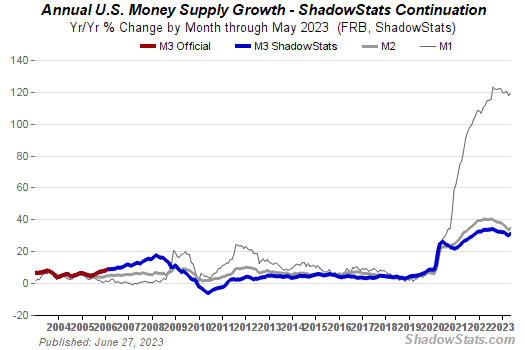
The Federal Reserve stopped publishing M3, its broadest former money-supply measure, in 2006. ShadowStats continues an estimated M3 series using still-published components—such as M2, institutional money funds, and portions of large time deposits—together with proprietary modeling. It also presents Basic M1 as currency plus demand deposits to preserve a narrower view of highly liquid money.
Money-supply growth does not translate mechanically into property-price growth, inflation, or easier credit. Bank capital, lending standards, borrower quality, interest rates, investor risk appetite, and the velocity of money all affect how liquidity reaches real estate markets.
Property-management and investment lens
- Compare broad liquidity conditions with actual lender quotes and underwriting standards.
- Review debt maturities and refinancing exposure rather than assuming liquidity is equally available to every borrower.
- Consider whether easier or tighter financial conditions are influencing transaction volume, cap-rate expectations, or seller behavior.
- Use the series as macroeconomic context, not as a direct forecast of rents or values.
Income and demand
A Broader View of Unemployment
The official U-3 unemployment rate is the widely reported headline measure. U-6 is broader because it also includes certain marginally attached workers and people working part-time for economic reasons. ShadowStats begins with U-6 and adds its estimate of long-term discouraged workers whom it says were removed from official definitions in the 1990s.
A broader measure can be useful when evaluating labor-market slack and household financial pressure, but it remains a national estimate built on ShadowStats' assumptions. Rental performance is often more sensitive to local industries, wages, job concentration, household formation, and the tenant mix at a particular property.
Property-management and investment lens
- Track collections, payment plans, concessions, and renewal behavior for evidence of tenant stress.
- Evaluate local employment concentration rather than relying solely on a national rate.
- Consider how weaker labor conditions could shift demand toward smaller units, roommates, or lower-cost housing.
- For commercial property, monitor tenant sales, staffing, closures, and lease-renewal discussions.

Purchasing power and expenses
Alternative Inflation Measures
ShadowStats publishes alternative CPI estimates based on its interpretation of methodologies used before later revisions to official inflation measurement. One public chart presents a 1990-based alternative, while another presents a 1980-based alternative. ShadowStats argues that changes to official methodology lowered reported inflation relative to a constant-standard-of-living concept.
These series are not official BLS measures, and their methodology and conclusions are disputed. Their practical value is as a stress-testing lens: if purchasing-power erosion or operating-cost pressure is greater than the official CPI suggests, how resilient are the property's rents, reserves, debt coverage, and tenant base?
Property-management and investment lens
- Compare alternative inflation scenarios with trailing property expenses rather than applying a national rate mechanically.
- Review insurance, utilities, maintenance labor, supplies, taxes, and service contracts separately because they rarely move together.
- Distinguish nominal rent growth from real improvement in purchasing power or operating margin.
- Stress-test capital reserves and replacement schedules against higher cost assumptions.


Economic activity
Alternative GDP and Property Demand
Official real GDP adjusts nominal output for inflation. ShadowStats publishes an alternative year-over-year real GDP series that incorporates its alternative inflation assumptions and critiques of official methodology. Its public chart emphasizes annual growth rather than the annualized quarter-to-quarter rate often featured in headlines.
GDP is a broad national measure. Property demand can strengthen in one region or asset class while weakening in another. Local supply, population movement, industry concentration, household formation, credit conditions, and development pipelines often matter more for an individual property.
Property-management and investment lens
- Use weaker growth scenarios to test rent growth, absorption, concessions, and bad-debt assumptions.
- For commercial property, examine tenant industries, sales exposure, and lease rollover concentration.
- Review development and capital plans under slower demand and longer stabilization periods.
- Separate national economic weakness from local markets supported by durable employment or constrained supply.

Currency and imported costs
Alternative U.S. Dollar Index
ShadowStats' financial-weighted dollar index uses foreign-exchange trading volume to weight the U.S. dollar against six major currencies: the euro, yen, pound, Swiss franc, Australian dollar, and Canadian dollar. ShadowStats contrasts this approach with a Federal Reserve index weighted by merchandise trade.
A currency index does not translate directly into a specific property expense. Exchange rates interact with supply chains, commodity markets, tariffs, domestic capacity, transportation, and vendor pricing. The series is most useful for examining one possible channel through which global financial conditions may affect real estate costs and capital flows.
Property-management and investment lens
- Monitor imported appliances, fixtures, mechanical equipment, and building products when currency conditions shift.
- Consider how exchange-rate moves may interact with energy and commodity pricing.
- For markets with significant foreign investment, examine potential effects on capital flows and transaction demand.
- Confirm all implications with current supplier pricing, bids, and financing terms.

From macro data to property action
A Four-Step Decision Framework
Alternative indicators are most useful when they lead to a specific, testable question. They are least useful when they are treated as automatic predictions. Use the following process to connect the charts with a real property decision.
Define the Decision
Specify whether you are evaluating a purchase, refinance, renewal strategy, operating budget, reserve contribution, renovation, or disposition.
Identify the Transmission Channel
Determine how the economic issue could reach the property through debt, tenant income, expenses, capital costs, demand, or valuation.
Find Property Evidence
Review leases, rent rolls, delinquency, vacancy, bids, invoices, insurance, utilities, debt terms, and local comparables.
Stress-Test the Outcome
Model a reasonable range rather than relying on a single forecast. Test whether cash flow and reserves remain adequate under less favorable conditions.
| Property question | Relevant alternative lens | Property evidence to verify |
|---|---|---|
| Can the property support a refinance? | Money supply, inflation, GDP | Actual lender terms, DSCR, loan maturity, reserves, and valuation sensitivity. |
| Are tenants under increasing financial pressure? | Unemployment, inflation | Collections, payment plans, renewal behavior, concessions, income trends, and local employment. |
| Are operating margins being overstated? | Inflation, dollar index | Trailing expenses, insurance renewals, utility tariffs, vendor bids, and replacement costs. |
| Is projected demand too optimistic? | GDP, unemployment | Local supply, absorption, population, household formation, job concentration, and concessions. |
| Does the capital plan need a larger contingency? | Inflation, dollar index, money supply | Current project scope, material quotes, labor bids, lead times, financing availability, and reserves. |
The property record remains the final test
National economic series can describe the environment, but they do not determine the appropriate rent, repair budget, reserve balance, loan structure, or purchase price for a specific asset. The final decision should be supported by current local evidence and the property's own operating history.
Source transparency
Methodology, Chart Use, and Limitations
ShadowStats is an independent publisher of proprietary alternative economic estimates. Its series are not official statistics from the Federal Reserve, Bureau of Labor Statistics, Bureau of Economic Analysis, or another government agency. The estimates, methodological claims, and interpretations are those of ShadowStats and are subject to debate.
Basic Property Management displays the public charts under ShadowStats' chart republication terms. Each image is hotlinked to the publisher, remains unmodified, and links to the relevant ShadowStats source page. ShadowStats controls the chart files, update timing, historical coverage, availability, methodology, and continued permission to republish them.
Because the charts may have different publication schedules and historical endpoints, this page does not publish a single universal “last updated” date. Readers should review the publication date and data period printed within each chart and consult the linked source page before relying on the information.
Chart republication terms
ShadowStats states that public charts may be republished when they remain unmodified and include the required link. It encourages hotlinking for publishers who want replacement chart images to appear automatically. Review the current ShadowStats chart-use requirements before changing the implementation.
Questions and interpretation
Alternative Economic Data FAQ
Does this page claim that official economic data are wrong?
No. The page presents ShadowStats as an alternative analytical framework. Official statistics remain the standard reference for most policy, lending, appraisal, and market analysis. Comparing methodologies can help readers understand assumptions and test risk, but it does not establish that one series is universally correct.
Do the ShadowStats charts update automatically?
The images are hotlinked from ShadowStats. If the publisher replaces a chart at the same source address, the revised image can appear here automatically. ShadowStats controls whether, when, and how a chart is updated, and it may change or discontinue the service.
Why might the charts have different ending dates?
The underlying measures have different source schedules, production processes, and publication decisions. Use the date printed within each chart rather than assuming that every image covers the same period.
Can an alternative inflation rate determine a rent increase?
No. A rent decision should account for local comparable rents, lease terms, concessions, unit condition, vacancy, turnover cost, tenant retention, and applicable law. Inflation data can provide context, but it is not a property-specific rent recommendation.
Can national alternative data predict a local property market?
No single national series can do so reliably. Local employment, housing supply, migration, household income, development, lending conditions, and property quality can produce results that differ materially from national trends.
What should be reviewed before acting on these indicators?
Compare the alternative charts with official data, then review current lender terms, local market evidence, rent rolls, leases, financial statements, maintenance history, vendor bids, insurance, utilities, taxes, and reserve requirements.
Continue the analysis
Compare the Alternative View With Official Market Data
Use the official dashboard for established mortgage-rate, inflation, rent, construction-cost, and unemployment indicators. Then apply both perspectives to property-level underwriting and operating decisions.
Educational-use and third-party data notice
This page is provided for general informational and educational purposes. It does not provide financial, legal, tax, lending, appraisal, construction, property-management, or investment advice. Alternative estimates may be delayed, disputed, revised, unavailable, or based on assumptions that differ from official methodology. Local conditions and individual property performance may differ materially.
ShadowStats charts and related methodologies are owned and controlled by ShadowStats. Loading a chart connects the visitor's browser to the ShadowStats website. Basic Property Management does not control the external chart files, their availability, update frequency, data accuracy, privacy practices, or continued permission for use. Consult qualified professionals and verify current source information before acting.