How To Use Predictive Maintenance Data in Property Management
Property management has historically operated on two primary maintenance models. The first is reactive maintenance—waiting for something to break and then rushing to fix it. The second is preventive maintenance—scheduling routine service based on a calendar, regardless of whether the equipment actually needs it.
Both models have significant flaws. Reactive maintenance leads to expensive emergency repairs, frustrated tenants, and shortened equipment lifespans. Preventive maintenance, while better, often results in over-servicing equipment and wasting labor hours on healthy systems.
A third model is rapidly becoming the industry standard: predictive maintenance. By leveraging data, sensors, and analytics, property managers can now forecast equipment failures before they happen. This shift from calendar-based to condition-based maintenance is fundamentally changing how properties operate, reducing costs, and improving the tenant experience.
What is Predictive Maintenance?
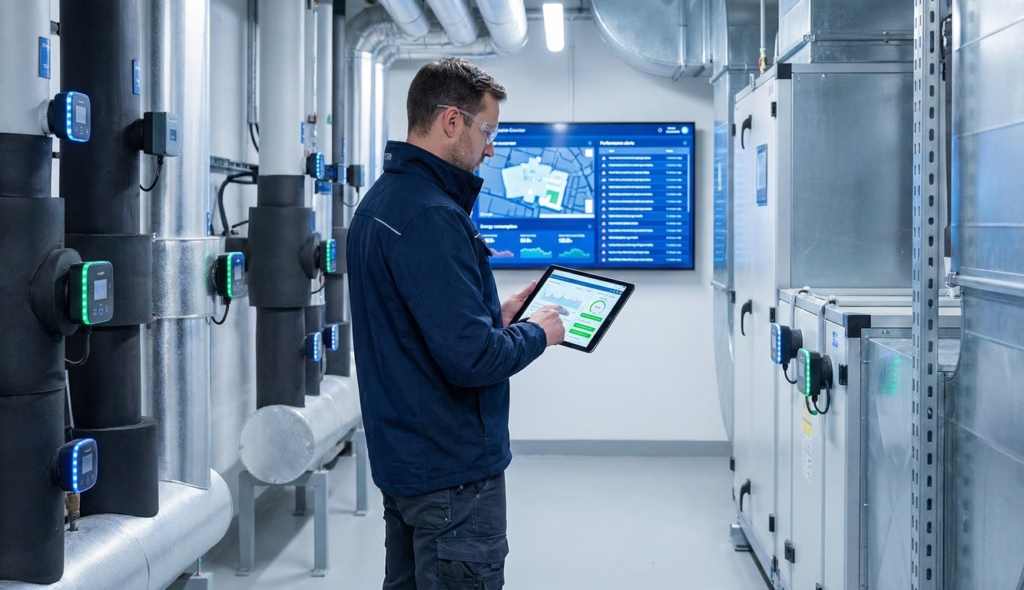
Predictive maintenance uses real-time data to monitor the actual condition of building systems and equipment. Instead of guessing when an HVAC unit might fail based on its age, predictive systems measure specific performance indicators—like vibration, temperature, and energy consumption—to identify the early warning signs of a breakdown.
This approach relies heavily on the Internet of Things (IoT). Small, inexpensive sensors are attached to critical building systems. These sensors continuously collect data and transmit it to a central software platform. The software analyzes the data, comparing current performance against historical baselines and manufacturer specifications.
When the system detects an anomaly—such as a motor drawing slightly more power than usual or a pump vibrating outside normal parameters—it triggers an alert. This allows maintenance teams to investigate and resolve the issue during normal business hours, long before the equipment actually fails.
The Financial Impact of Predicting Failures
The business case for moving away from reactive repairs is compelling. Emergency repairs are inherently expensive. They often require after-hours labor rates, expedited shipping for parts, and sometimes temporary solutions (like portable heaters) to keep tenants comfortable while the main system is down.
According to the U.S. Department of Energy, predictive maintenance is highly cost-effective, saving roughly 8 to 12 percent on preventive maintenance and up to 40 percent on reactive maintenance.
These savings come from several distinct areas:
1. Eliminating Catastrophic Failures
When a small component fails, it often damages surrounding parts. A worn bearing in an HVAC motor might cost $50 to replace. If left until it fails completely, it could destroy the entire motor, turning a minor repair into a $2,000 replacement. Predictive systems catch the worn bearing early.
2. Optimizing Labor Efficiency
Maintenance teams spend a significant portion of their time performing routine checks on equipment that is functioning perfectly. Predictive maintenance directs labor only to the equipment that actually requires attention. Technicians arrive at the unit already knowing what the problem is, reducing diagnostic time.
3. Extending Asset Lifespans
Equipment that runs efficiently and receives timely repairs lasts longer. By preventing the stress of catastrophic failures and ensuring systems operate within optimal parameters, property owners can defer massive capital expenditures for replacements.
Key Applications in Property Management
While predictive maintenance can be applied to almost any mechanical system, it delivers the highest return on investment in a few specific areas of property management.
HVAC Systems
Heating and cooling systems are the most common application for predictive technologies. They are expensive to replace, critical to tenant comfort, and prone to gradual degradation. Sensors can monitor airflow, refrigerant pressure, and compressor vibration. A gradual increase in energy consumption often indicates a clogged filter or a failing component, allowing for a targeted intervention before the system stops cooling on the hottest day of the year.
Plumbing and Water Systems
Water damage is one of the most expensive risks in property management. Predictive systems use moisture sensors and flow meters to detect leaks the moment they start. Sensors detect changes in air quality, humidity, and temperature, providing data that helps maintain optimal living conditions and prevent potential health hazards like mold growth. Furthermore, monitoring water pressure can identify failing pumps in high-rise buildings before residents lose water pressure.
Elevators
Elevator downtime is a major source of tenant complaints in multi-family and commercial buildings. Predictive sensors monitor door operation times, motor temperature, and cable tension. By identifying a door that is closing a fraction of a second slower than normal, technicians can adjust the mechanism before the elevator gets stuck between floors.
Implementing a Predictive Strategy
Transitioning to a predictive maintenance model does not require ripping out existing building systems. The technology is designed to integrate with legacy equipment.
Start Small and Scale
The most successful implementations begin with a pilot program. Property managers typically identify their most critical or problematic assets—often the main HVAC chillers or boilers—and install sensors on those specific units. Once the system proves its value by preventing a few failures, the program can be expanded to other equipment.
Leverage Digital Twins
Advanced property management operations are increasingly using digital twins to manage their predictive data. A digital twin in property management is a virtual replica of your physical properties that combines real-time data from sensors, maintenance records, and resident behavior patterns. This creates a centralized dashboard where managers can view the real-time health of every asset across their entire portfolio.
Train the Maintenance Team
Technology is only as effective as the people using it. Maintenance teams must be trained to trust the data and respond to alerts proactively. The workflow shifts from responding to tenant complaints to responding to system alerts. This requires a cultural shift within the maintenance department, moving from a reactive mindset to a proactive one.
Want To Skip the Costly Learning Curve in Real Estate Investing and Property Management?
Access comprehensive real estate investing guides written by a CCIM-certified expert with over three decades of experience.

Master the art of real estate investing with The Real Estate Property Management Guide: Premium Edition – your comprehensive roadmap to successful property management.
Whether you’re a novice investor or seasoned professional, this guide covers everything from selecting the right investment properties to tenant management and property marketing.
The author, Jeff Rohde writing as Jeffrey Roark, is a professional with over 25 years of real estate experience.
This Premium Edition includes the valuable bonus book Investment Real Estate Analysis: A Case Study to help you identify hidden opportunities and evaluate properties like a professional.
Access practical, actionable strategies for both residential and commercial properties, from single-family homes to office buildings and shopping centers.