Power Constrained Commercial Real Estate and the NextEra Dominion Merger

The proposed NextEra Energy acquisition of Dominion Energy is not just a utility-sector transaction. For commercial real estate investors, it is a warning that electricity access is becoming a core investment variable.
NextEra agreed to buy Dominion in an all-stock transaction valued at approximately $66.8 billion, creating one of the largest regulated utility platforms in the United States.
Dominion’s footprint includes Virginia, one of the most important data center markets in the country, while NextEra brings scale in power generation, renewables, storage, and utility operations.
The deal is tied directly to the rising electricity demands created by artificial intelligence, cloud computing, data centers, and broader electrification trends, according to this Reuters report on the merger.
For commercial real estate, the strategic issue is not whether this specific merger closes. The larger issue is that power access is becoming a scarce asset. Investors who understand that shift may underwrite better deals.
Investors who ignore it may buy properties that look strong on paper but are limited by electrical capacity, long interconnection timelines, or rising utility costs.
Get Practical Property Management Tips Twice a Week
Want smarter systems for managing rentals, screening tenants, handling maintenance, and improving property performance? Sign up for our 2X weekly newsletter and get practical property management and real estate investing insights delivered straight to your inbox.
Why Power Is Becoming a CRE Investment Variable
Commercial real estate underwriting has traditionally focused on rent, occupancy, cap rates, tenant credit, location, debt costs, taxes, insurance, and replacement cost. Those still matter. But a new question is moving up the diligence checklist: can the property get enough power, at the right cost, within the right timeline?
That question is no longer limited to data centers. It affects industrial buildings, cold storage, medical office, life sciences, EV charging sites, advanced manufacturing, large multifamily properties, and even retail centers that want to support high-demand tenants.
The U.S. Department of Energy has estimated that data centers consumed about 4.4% of total U.S. electricity in 2023 and could consume roughly 6.7% to 12% by 2028. That is a material shift in electricity demand and grid planning. See the Department of Energy’s analysis of data center electricity demand.
This creates a direct real estate consequence. A site with available power can be more valuable than a similar site that needs major utility upgrades. A market with supportive transmission capacity can attract investment that bypasses more constrained locations. A building with existing electrical infrastructure may become more competitive than a newer building with limited power expandability.
The Merger Signal Investors Should Not Miss
The NextEra-Dominion deal highlights a broader market reality: electricity demand is becoming large enough, complex enough, and capital-intensive enough to reshape utility strategy.
Utilities need capital to build generation, transmission, storage, and grid resilience. Data center operators need speed to power. Developers need certainty before committing capital. Local governments want tax revenue but may face voter resistance, ratepayer pressure, and infrastructure stress.
That combination changes how commercial real estate investors should think about market selection.
A market is no longer attractive simply because population is growing or rents are rising. Investors also need to understand whether the local power grid can support the uses that will drive future demand. In some cases, power availability may reinforce existing growth markets. In others, it may shift demand toward secondary markets that have more capacity, more land, or more cooperative utility planning.
Data Centers Are the Obvious Driver
Data centers are the clearest example of power constrained commercial real estate. They need land, fiber, water or cooling solutions, security, tax incentives, zoning approval, and enormous electrical capacity. Without power, the rest of the site attributes matter much less.
CBRE has reported that many planned data center projects remain delayed because of permitting, zoning, and power procurement hurdles. CBRE also noted that new capacity under construction in primary North American data center markets declined at the end of 2025, despite strong demand, because infrastructure constraints are becoming harder to solve. See CBRE’s North America Data Center Trends.
For CRE investors, this means data center demand can affect land pricing even if they never plan to own a data center. Industrial land near substations, transmission corridors, and fiber routes may attract more interest. Utility-served development sites may trade at premiums. Markets with long power delivery timelines may see projects delayed or redirected.
The important point is not that every investor should become a data center developer. Most should not. The important point is that data center demand can change the value of nearby industrial land, infrastructure-adjacent sites, and markets with available grid capacity.
Industrial Real Estate Will Feel the Impact First
Industrial real estate is likely to feel the broadest impact from rising power demand.
Older industrial underwriting often focused on clear height, loading, truck access, highway proximity, parking, labor, and submarket vacancy. Those remain essential. But power capacity is becoming a differentiator, especially for users that rely on automation, refrigeration, fleet charging, robotics, manufacturing, or heavy equipment.
A warehouse that was adequate for storage may not be adequate for a modern tenant with automation and EV charging needs. A flex industrial building that worked for light manufacturing may struggle if a tenant needs higher amperage, backup power, or upgraded transformers.
Investors evaluating industrial assets should now ask specific power-related questions:
- What is the existing service capacity?
- Can the building support expansion?
- Where is the nearest substation?
- Has the owner requested utility upgrade estimates?
- Are transformers, switchgear, and panels modern enough for future use?
- Would a tenant need six months, two years, or longer to get the power it needs?
These are not technical details to leave until late diligence. They can affect leasing, capital expenditure budgets, tenant improvement costs, and exit value.
Cold Storage and Food Logistics May Gain Importance
Cold storage is another property type that may benefit from better power-aware underwriting. Refrigerated facilities are energy intensive, and demand is supported by grocery distribution, food delivery, pharmaceuticals, and temperature-controlled logistics.
However, cold storage is not easy to retrofit. Power, insulation, equipment, truck circulation, ceiling heights, slab conditions, and location all matter. If electrical capacity is constrained, conversion costs can become unrealistic.
Investors should avoid assuming that any warehouse can become cold storage simply because demand exists. In a power constrained commercial real estate market, the right question is whether the building already has the infrastructure foundation for the intended use.
Retail Centers May Have Hidden Power Optionality
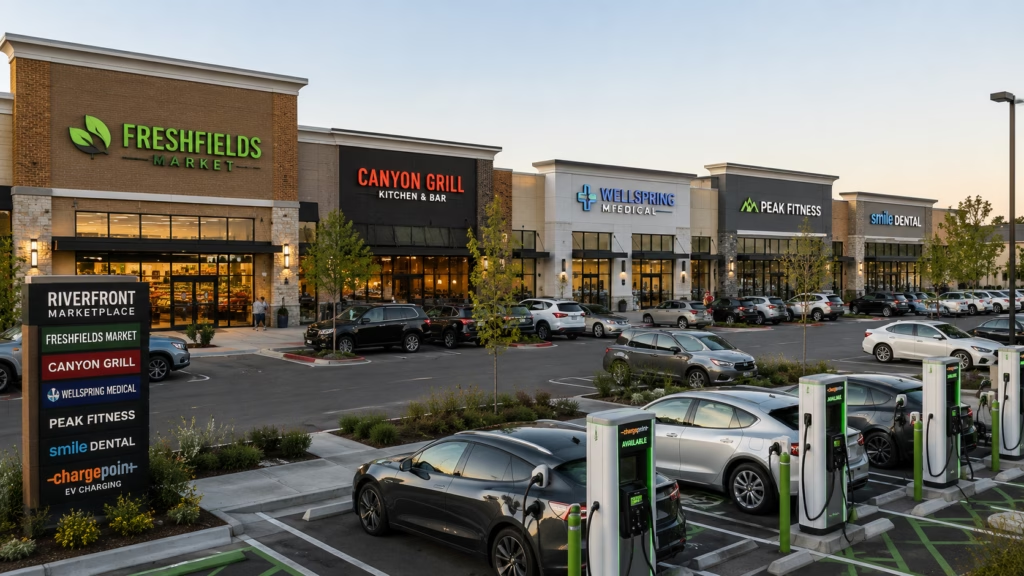
Retail investors should also pay attention. Grocery stores, restaurants, medical tenants, fitness operators, and EV charging providers can all require more electrical capacity than traditional small-shop tenants.
A well-located retail center with excess parking, strong utility access, and a supportive local power provider may have optionality. It might support EV charging, quick-service restaurant pads, medical users, or higher-credit anchor tenants. A similar center with limited service capacity may have fewer redevelopment paths.
This matters for value-add retail. Investors often focus on rent roll improvement, facade upgrades, tenant mix, and pad development. Those are important, but electrical infrastructure can determine whether the desired tenant plan is realistic.
Before underwriting a major repositioning, investors should review the existing service, available capacity, transformer locations, panel limitations, and likely utility upgrade timeline. A retail center with strong power access may deserve a better redevelopment plan than one based only on cosmetic improvements.
Office Repositioning Also Depends on Electrical Capacity
Office investors are already dealing with difficult market conditions in many cities. Higher vacancy, refinancing pressure, and weaker tenant demand have forced many owners to consider repositioning.
Power matters here as well.
A traditional office building may not have the electrical infrastructure needed for medical office, lab conversion, education, government use, data-heavy tenants, or mixed-use redevelopment. Even ordinary tenant expectations can require upgrades, including better HVAC systems, security, backup systems, charging stations, and digital infrastructure.
In weak office markets, power constraints can separate feasible conversion candidates from speculative ones. An office building with strong location but inadequate electrical infrastructure may require more capital than the acquisition price suggests.
Multifamily Investors Should Watch Utility Costs and Charging Demand
Multifamily investors may not face the same power requirements as data centers or industrial users, but they are not insulated.
Large apartment communities increasingly need to think about EV charging, HVAC efficiency, common-area electricity, smart building systems, backup power, and utility billing structures. In high-growth markets, residents may expect charging access. In older properties, electrical upgrades can become a major capital planning issue.
Power constraints can also affect operating expenses. If utility rates rise because of grid investment, generation needs, or transmission upgrades, landlords may face higher common-area costs and more tenant sensitivity around total housing costs. Properties with poor energy efficiency may become less competitive.
For multifamily acquisitions, investors should review utility expense history, submetering, electrical capacity, HVAC age, common-area systems, and whether the property can support charging infrastructure without major redesign.
Build a Stronger Rental Property Business
Subscribe to our 2X weekly newsletter to learn more about managing tenants, protecting cash flow, improving rental operations, and making better real estate investment decisions.
A Practical Due Diligence Checklist for Investors
Power-aware due diligence does not require every investor to become an electrical engineer. It does require better questions and earlier review.
Review Existing Electrical Infrastructure
Request electrical plans, utility bills, service capacity information, panel schedules, transformer details, and any prior utility correspondence. For larger assets, consider bringing in an electrical engineer earlier than usual.
Confirm Upgrade Feasibility
Do not assume utility upgrades are quick or affordable. Ask the serving utility about capacity, likely timelines, cost-sharing requirements, and whether nearby infrastructure is already constrained.
Match Power Capacity to Target Tenants
A generic “industrial tenant” is not specific enough. Cold storage, robotics, manufacturing, EV fleet users, and distribution tenants can have very different electrical needs. Underwrite the property against the tenant profile you actually want.
Evaluate Market-Level Grid Constraints
Power constraints are not only property-specific. Some markets have more congested interconnection queues, more political resistance, or more ratepayer pressure. Others may be better positioned for infrastructure growth.
Include Power in Exit Strategy
A future buyer may ask more detailed questions about power capacity than buyers did five years ago. If the property has strong electrical infrastructure, document it. If it has weaknesses, underwrite the cost and timeline to fix them.
Free Power-Constrained CRE Due Diligence Checklist
Power availability can now affect acquisition pricing, leasing strategy, redevelopment timelines, and exit value. Subscribe to our 2X weekly newsletter and get the free Power-Constrained CRE Due Diligence Checklist in editable Word and fillable PDF formats. Use it to evaluate utility capacity, electrical infrastructure, upgrade timelines, tenant fit, and power-related investment risk before committing capital.
How This Could Change CRE Investment Strategy
The rise of power constrained commercial real estate may change strategy in several ways.
First, infrastructure-adjacent land may become more valuable. Sites near substations, transmission, fiber, and major utility corridors could receive more attention from developers and institutional investors.
Second, older buildings with strong electrical infrastructure may be mispriced. Some assets may look ordinary in listing materials but offer valuable power capacity that supports higher-value tenants.
Third, speculative redevelopment may become riskier. A business plan that depends on attracting energy-intensive tenants can fail if the property cannot get power on schedule.
Fourth, secondary markets may benefit. If core data center and industrial markets become constrained, demand may move to areas with better utility access, lower land costs, and supportive local governments.
Fifth, underwriting timelines may need to expand. Power availability should be addressed before a buyer spends heavily on design, zoning, or tenant negotiations.
What Landlords and Investors Should Do Now
Commercial real estate investors do not need to overreact to one utility merger. But they should treat the transaction as evidence of a larger trend.
Start by adding power capacity to acquisition checklists. Then review existing portfolio assets for hidden strengths or weaknesses. Industrial, retail, office, and multifamily owners should identify which properties can support higher-demand uses and which may require upgrades.
For new acquisitions, investors should ask power questions before final pricing. A building with strong infrastructure may justify a premium. A building with weak infrastructure may require a larger capital reserve or a lower offer.
The best investors will not chase every AI or data center headline. They will translate the power-demand trend into practical underwriting. That means better diligence, better tenant targeting, better redevelopment planning, and more realistic capital budgets.
Are You Looking To Connect With Property Owners, Landlords, and Real Estate Investors?
Grow your business by connecting with property professionals with our cost-effective advertising options.