
How AI Infrastructure Spending Is Impacting Real Estate
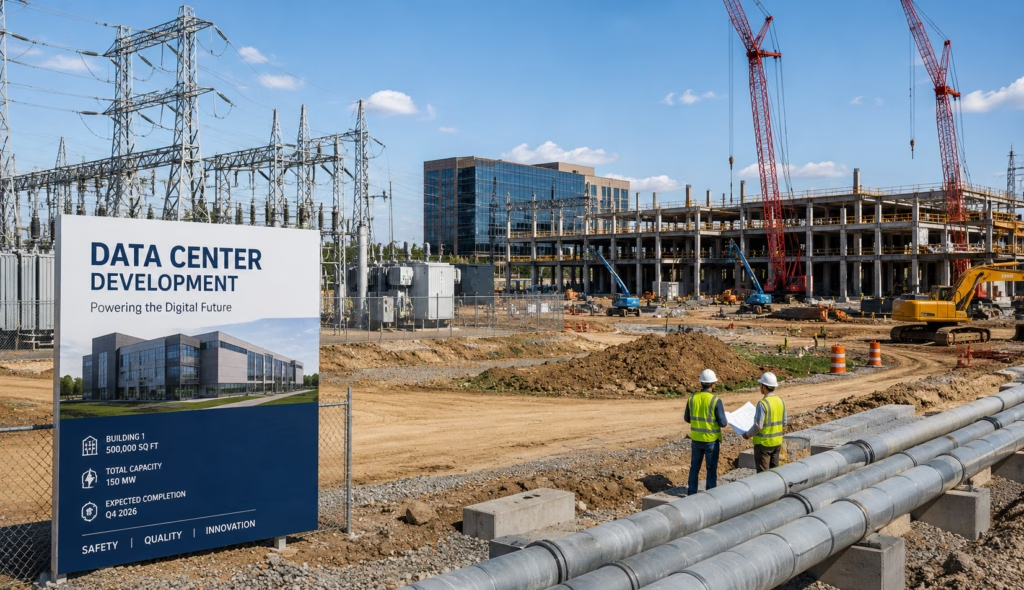
Artificial intelligence is often discussed as software, but its first major economic impact is physical. Before AI can transform offices, leasing, property management, logistics, or investment analysis, it needs data centers, chips, power, cooling systems, fiber networks, substations, and highly specialized construction.
That is why AI infrastructure spending has become one of the most important real estate stories of the decade.
In its report on AI’s impact on the economy, employment, and productivity, CBRE argues that the AI buildout is already influencing macroeconomic growth, capital allocation, and commercial real estate demand. The key point for real estate investors is simple: AI is not only a technology trend. It is an infrastructure cycle.
For landlords, investors, developers, and property managers, this matters even if they never own a data center. Large infrastructure cycles reshape local labor markets, utility planning, land values, industrial demand, office demand, tax bases, and operating costs.
The benefits will not be distributed evenly. Some markets will attract new investment, while others may face higher power costs, permitting conflicts, or limited grid capacity.
Why AI Infrastructure Spending Matters
AI models require massive computing capacity. That capacity is housed in data centers, and data centers require large amounts of electricity, water, cooling equipment, backup generation, security, and network connectivity.
This changes the way investors should think about AI. The economic impact is not limited to software companies or public technology stocks. It extends into land acquisition, construction, utilities, engineering, industrial real estate, and local government planning.
The AI infrastructure cycle creates demand for several categories of physical assets:
Data Centers
The most obvious impact is data center development. AI workloads require dense computing environments with high power capacity and advanced cooling systems. These facilities are expensive to build, difficult to entitle, and heavily dependent on power availability.
Traditional real estate analysis often starts with population growth, rent growth, cap rates, and supply pipelines. AI data center development adds another variable: can a market deliver enough power, land, fiber, and permitting certainty to support large-scale digital infrastructure?
Power and Grid Infrastructure
Power is becoming one of the main constraints in the AI buildout. Data centers need reliable electricity around the clock. In many markets, the limiting factor is no longer tenant demand or capital availability. It is whether the grid can support the load.
The International Energy Agency has noted that global electricity demand from data centers is rising quickly, with AI-focused facilities growing faster than broader electricity demand. Its energy and AI analysis shows why data center growth has become a major energy-planning issue, not just a technology-sector concern.
For real estate investors, this creates both opportunity and risk. Properties near constrained substations may face higher utility costs or delayed service upgrades. At the same time, land with access to reliable power could become more valuable, especially in markets with strong fiber connectivity and supportive local governments.
Industrial and Construction Demand
AI infrastructure spending also supports demand for contractors, equipment suppliers, logistics providers, and industrial users. Data centers require transformers, switchgear, backup power systems, cooling equipment, structural materials, and specialized construction labor.
This can benefit industrial real estate in several ways. Suppliers may need more warehouse or manufacturing space. Contractors may need staging yards and logistics facilities. Equipment bottlenecks may increase demand for storage and distribution capacity near major construction hubs.
The result is that AI infrastructure can influence industrial markets even where the data centers themselves are not located.
Why This Is Not Just a Data Center Story
A common mistake is to treat AI infrastructure spending as a narrow data center investment theme. That is too limited.
Data centers are the anchor asset, but the broader economic effect spreads across adjacent property types and local markets. A large AI infrastructure project can affect:
Land Values
Large users with major power needs can change the value of previously overlooked land. Sites that were less attractive for residential or retail development may become valuable if they offer acreage, transmission access, fiber routes, and distance from dense residential opposition.
For investors, this means land underwriting should include utility access, not just zoning and location. A parcel that looks ordinary from a traditional development perspective may have strategic value if it sits near power infrastructure.
Local Labor Markets
Major data center and utility projects can bring construction jobs, engineering work, and long-term technical roles. The direct employment from a data center may be lower than from a large office campus or manufacturing plant, but the construction phase and vendor ecosystem can still be meaningful.
This can support local housing demand, especially in smaller markets where large infrastructure projects represent a noticeable share of economic activity.
Municipal Revenue
Data centers can expand the local tax base, but they can also create political debate. Communities may welcome investment and tax revenue, while residents may object to power use, water use, noise, land consumption, or limited permanent job creation.
For real estate investors, the political environment matters. A market that is initially attractive because of land and power availability may become less attractive if permitting becomes contentious.
Utility Costs
One of the less obvious risks is utility cost pressure. If data center demand requires major grid upgrades, the question becomes who pays for that infrastructure. In some cases, utilities, regulators, and large customers may negotiate cost allocation. In others, broader ratepayers may worry about higher electricity costs.
The U.S. Department of Energy has emphasized that data center electricity demand is regionally concentrated and can create grid-planning challenges. Its discussion of clean energy resources for data centers highlights the importance of reliability, regional constraints, and firm power supply.
Property owners should watch this carefully. Rising utility costs can affect operating expenses for multifamily, office, retail, and industrial assets. Even investors with no direct exposure to data centers may feel the impact through higher power bills.
What Real Estate Investors Should Watch
AI infrastructure spending creates a new set of underwriting questions. Investors do not need to become data center specialists, but they should understand how this cycle may affect markets and asset values.
Is the Market Power-Constrained or Power-Advantaged?
Power availability is becoming a competitive advantage. Markets with available capacity, strong transmission infrastructure, and supportive utilities may attract more AI-related development. Markets with long interconnection delays may struggle, even if they have cheap land.
Investors should pay attention to utility announcements, transmission projects, substation capacity, and local government incentives.
Are Local Officials Supportive?
Permitting risk is a major issue. A city or county may want economic development, but residents may oppose large data center projects due to concerns about power use, water demand, traffic, or visual impact.
A market with clear rules and predictable approvals is more attractive than one where each project becomes a political fight.
Does the Market Have Adjacent Industrial Demand?
Even if a data center itself is owner-occupied or controlled by a hyperscaler, surrounding industrial properties may benefit. Look for demand from electrical contractors, cooling equipment vendors, logistics providers, engineering firms, and maintenance companies.
This is especially relevant in secondary and tertiary markets where a few large infrastructure projects can meaningfully affect local industrial absorption.
Could Utility Costs Affect Existing Properties?
For landlords, higher utility costs can reduce net operating income if those costs cannot be passed through to tenants. This matters most for properties where owners absorb common-area electricity, heating, cooling, or water costs.
Multifamily owners should monitor utility trends closely. Commercial landlords should review lease structures to understand which costs are recoverable and which remain the owner’s responsibility.
Risks in the AI Infrastructure Buildout
The AI infrastructure boom is not risk-free. CBRE’s report notes that AI-related investment could support growth if productivity gains arrive, but it could also create downside risk if valuations and capital spending outrun actual business returns.
For real estate investors, the major risks include:
Overbuilding
Infrastructure cycles can overshoot. If AI demand grows more slowly than expected, some markets may end up with excess data center capacity or speculative land positions that do not perform as planned.
This does not mean the AI infrastructure theme is weak. It means investors should avoid assuming that every data center-adjacent market will automatically benefit.
Grid Bottlenecks
Power constraints can delay projects, increase costs, and shift development to other markets. A site may be attractive on paper but impractical if power delivery is years away.
Community Pushback
Data centers can face opposition from residents concerned about noise, land use, water consumption, and electricity demand. Local politics can slow or stop projects.
Concentration Risk
Some markets may become heavily dependent on a small number of large technology users. That can create attractive near-term growth but also expose local economies to changes in corporate capital spending.
Practical Takeaways for Landlords and Investors
AI infrastructure spending should be treated as a market signal, not a guaranteed investment thesis.
For residential landlords, the key question is whether infrastructure investment is bringing durable employment, construction activity, and income growth to the area. If so, it may support rental demand. But landlords should also watch utility costs and local tax policy.
For commercial investors, the opportunity may be in industrial properties, contractor yards, flex space, and land near power and fiber infrastructure. Office demand may also evolve over time as AI companies, engineering firms, and infrastructure-related service providers expand in certain markets.
For property managers, AI infrastructure growth may affect operating budgets. Electricity, water, maintenance costs, and vendor pricing could shift in markets where infrastructure demand is intense.
For developers, utility access should move higher in the site-selection process. In some cases, power availability may be as important as road access, zoning, or demographics.
Final Thoughts AI Infrastructure Spending
AI may eventually transform productivity, employment, and business operations, but the first visible impact is infrastructure spending. Data centers, power systems, cooling equipment, fiber networks, and construction activity are the physical foundation of the AI economy.
The real estate lesson is straightforward: follow the infrastructure.
Markets that can support AI-related development may see new investment, stronger industrial demand, and rising land values. Markets that lack power capacity or permitting clarity may miss out. At the same time, property owners should watch for higher utility costs, community opposition, and the risk of overbuilding.
AI infrastructure spending is not just a technology story. It is a real estate, energy, and local economic development story. Investors who understand that connection will be better positioned to evaluate both the opportunity and the risk.
Are You Looking To Connect With Property Owners, Landlords, and Real Estate Investors?
Grow your business by connecting with property professionals with our cost-effective advertising options.