BEYOND THE MLS: MASTER THE FORECLOSURE MARKET
A professional's guide to identifying, analyzing, and acquiring off-market and distressed properties. No fluff, just data-driven strategy.
THE INVESTOR'S EDGE
For the disciplined real estate investor and the astute real estate professional, the greatest opportunities are often found where others aren't looking. The public market is crowded and competitive, but a significant—and potentially more profitable—segment of the market operates in the background: distressed properties.
Foreclosures, pre-foreclosures, and bank-owned properties represent a consistent stream of off-market inventory. However, accessing and navigating this landscape requires a specialized approach. Success is not accidental; it is the result of superior information, disciplined analysis, and strategic timing.
This is why we have partnered with Foreclosure.com, the nation's most comprehensive database of distressed assets. Our goal is to provide you with not only direct access to these opportunities but also the fundamental knowledge to act on them with precision and confidence.
THE FOUR PILLARS OF FORECLOSURE INVESTING
To effectively capitalize on the foreclosure market, one must first understand its structure. Each stage of the foreclosure process presents a distinct type of opportunity with its own set of rules, risks, and potential rewards. Below, we examine the four primary categories of distressed property listings.
1. The Pre-Foreclosure Stage: Strategic Negotiation
A pre-foreclosure is a property where the owner has defaulted on their mortgage payments, and the lender has initiated the legal process of foreclosure, but the owner still legally holds the title. This period represents a critical window of opportunity.
- The Opportunity: The property owner is a motivated seller, often seeking to avoid the credit damage of a formal foreclosure. This allows for direct negotiation, potentially resulting in a purchase price below market value and more flexible terms than a traditional sale. You are solving a problem for the seller while securing a valuable asset.
- The Strategy: Success in this stage hinges on your ability to identify these properties early and approach the owner with a credible, fair-market solution. It requires empathy, professionalism, and a clear value proposition. The goal is to create a win-win scenario before the property is lost to a public auction.
2. The Auction: High-Risk, High-Reward
If the owner cannot resolve the default, the property proceeds to a public auction, often known as a Sheriff Sale or Trustee Sale. Here, the property is sold to the highest bidder in a fast-paced, competitive environment.
- The Opportunity: Auctions can be the fastest way to acquire a property and, in some cases, at a significant discount. The opening bid is often set at the outstanding loan balance, which may be well below the property's market value.
- The Strategy: Diligence is non-negotiable. Properties are typically sold "as-is," with no inspection contingencies. Investors must conduct extensive research before the auction, including title searches and property valuations, often without interior access. This is a high-stakes environment best suited for experienced investors with readily available capital.
3. Bank-Owned (REO): A More Traditional Path
When a property fails to sell at auction, the lender takes formal ownership, and it becomes a Real Estate Owned (REO) asset. The bank’s primary goal is to liquidate the property to recover its losses, not to hold it as a long-term investment.
- The Opportunity: REO properties are often listed on the open market through a real estate agent, making the transaction process more similar to a traditional sale. Lenders are motivated to sell and may be willing to negotiate on price. These properties often have clear titles and may have been cleared of previous occupants.
- The Strategy: While more straightforward than an auction, REO investing still requires careful analysis. Investors should conduct a thorough inspection and be prepared for potential repairs, as these properties have often been vacant or poorly maintained. The key is to present a strong, well-structured offer to a motivated institutional seller.
4. The Short Sale: Complexity Meets Opportunity
A short sale occurs when a lender agrees to accept a mortgage payoff for less than the total amount owed. The property owner is "underwater," and selling is the only viable alternative to foreclosure.
- The Opportunity: The primary advantage is the potential to purchase a property for a price that can be substantially lower than its market value. It offers a discount that is often unavailable in the traditional market.
- The Strategy: Patience and persistence are paramount. A short sale requires the approval of the lender (and sometimes multiple lienholders), a process that can be lengthy and fraught with administrative hurdles. Working with a real estate professional experienced in short sale negotiations is highly recommended to navigate the complex communication and documentation requirements.
ACCESS NATIONWIDE FORECLOSURE LISTINGS NOW
FROM THEORY TO EXECUTION: THE PROFESSIONAL'S TOOLKIT
Foreclosure.com provides exactly that—a centralized, twice-daily updated database of distressed properties across the nation. It is the tool that bridges the gap between strategy and execution.
- Find Pre-Foreclosures Before the Competition: Get early access to properties in default, complete with the data you need to initiate contact.
- Track Auctions in Real-Time: Monitor upcoming sheriff sales and trustee sales with detailed property information to inform your bidding strategy.
- Filter REO & Short Sale Inventory: Efficiently search bank-owned and short sale listings that meet your specific investment criteria, from property type to location.
LATEST INSIGHTS
-
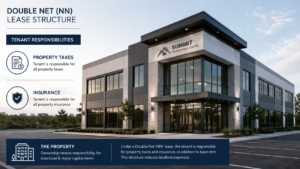
Double Net Lease Risks Hiding Below the Rent
A double net lease, often written as an NN lease, sits between a single net lease and a triple net lease. It can give landlords more expense protection than a gross lease, while giving tenants less responsibility than a full triple net lease. That middle position is useful, but it can also create confusion. If…
-
Landlord Insurance Mistakes That Can Wreck Cash Flow
Landlord insurance mistakes are easy to overlook because insurance often feels like a back-office task. You buy a policy, pay the premium, file it away, and hope you never need it. That approach can become expensive. The wrong policy, low coverage limits, vacancy exclusions, missing flood coverage, or weak liability protection can leave you exposed…
-
Rent Concessions That Help Protect Cash Flow
Rent concessions can help you fill a vacancy, retain a tenant, or compete in a softer rental market. Used carefully, they can protect income by reducing downtime. Used poorly, they can train tenants to expect discounts, weaken your rent roll, and make your property look less stable to buyers or lenders. A concession is an…
-
Why Vacancy Costs More Than One Month’s Rent
Rental property vacancy cost is often underestimated because landlords focus only on the obvious number: one month of lost rent. That is a start, but it is rarely the full cost. A vacant rental can also create turnover repairs, cleaning costs, utilities, lawn care, advertising, leasing fees, concessions, insurance exposure, security concerns, and additional owner…
-
One Vacancy Can Trigger Co-Tenancy Clause Risk
A co-tenancy clause can turn one retail vacancy into a much larger financial issue. If an anchor tenant leaves, occupancy drops, or a required tenant mix is not maintained, other tenants may gain the right to pay reduced rent, delay opening, or even terminate their leases. That makes co-tenancy language especially important in shopping centers,…
-
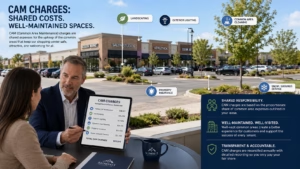
How CAM Common Area Maintenance Can Change Lease Costs
CAM, or common area maintenance, is one of the most important expense items in many commercial leases. It affects landlords, tenants, property managers, and investors because it determines how shared property costs are paid, estimated, reconciled, and disputed. If you are reviewing a retail, office, industrial, or mixed-use lease, CAM language deserves careful attention. The…