Posts Tagged ‘Property Managers’
How to Use Market Rent in Real Estate Investing

Market rent is the typical rental rate a property could command in the current market based on location, size, condition, and amenities, serving as a critical benchmark for determining rental property profitability. Getting this number wrong costs you money either through extended vacancies from overpricing or lost income from underpricing. Understanding the market rent potential…
Read MoreForeclosure Investment Automation Tools and Systems

Foreclosure investment automation leverages artificial intelligence and digital platforms to accelerate property analysis, risk assessment, and deal evaluation that once required extensive manual research. Investors now use technology to analyze comparable properties, calculate after-repair values, and uncover hidden risks in minutes. Automation tools have transformed foreclosure investing by enabling investors to process more deals faster,…
Read MoreClass B and C Property Conversion: A How-To Guide
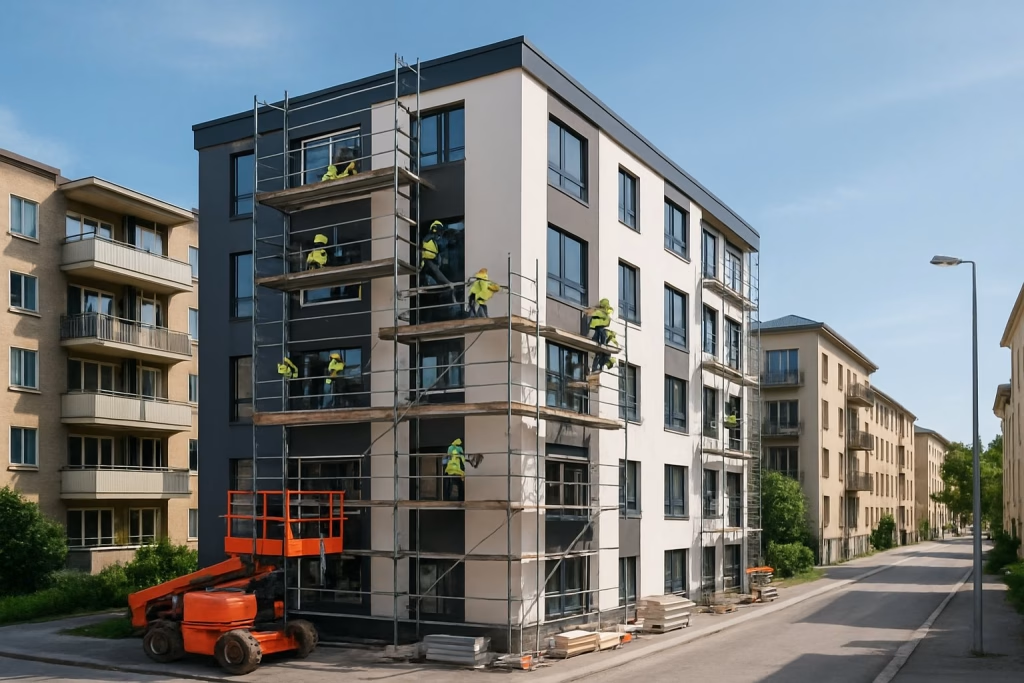
Converting older commercial properties into upgraded assets offers investors a pathway to higher returns in a competitive real estate market. Class B and C property conversions involve acquiring underperforming buildings and implementing strategic renovations to increase value, attract higher-quality tenants, and boost rental income. This strategy lets you purchase properties at lower prices and create…
Read MoreManaging Partner in Real Estate: Structure, Roles, and Agreements

The real estate industry relies on defined leadership structures to manage complex investments and operations. Within partnerships and firms, the managing partner holds significant authority and responsibility. Understanding this role gives real estate professionals insight into organizational dynamics that impact investment outcomes. A managing partner in real estate oversees daily operations, makes strategic decisions, and…
Read MoreForeclosure Property Staging for Maximum Profit

Foreclosure properties present unique challenges in the real estate market, but proper staging can transform these distressed assets into attractive homes that sell quickly and command better prices. Staging a foreclosure property involves strategically furnishing and decorating an empty or poorly maintained space to help potential buyers visualize themselves living there, which can reduce time…
Read MoreMixed-Use Development in Real Estate: Modern Urban Solutions

Developers and investors increasingly recognize the value of combining multiple property types within single developments. Mixed-use real estate integrates residential, commercial, retail, and office spaces into unified projects that serve diverse community needs while creating more profitable investments. These properties have become mainstream development strategies across cities of all sizes. Rising land costs and evolving…
Read MoreAccurate Foreclosure Property Valuation Methods

Foreclosure property valuation requires specialized methodologies distinct from traditional real estate appraisals. When evaluating distressed properties, adjust standard valuation approaches to account for limited access, property condition issues, and market stigma. Foreclosed homes typically sell for less than their estimated market value, with the discount varying significantly by region and property condition. Understanding this valuation…
Read MoreReal Estate Ground Lease: Key Structures, Terms, and Benefits

A ground lease is a long-term agreement where you lease land for 50 to 99 years and gain the right to develop buildings on it, while the landowner retains ownership of the underlying property. This arrangement enables access to prime commercial locations without the capital required to purchase land outright, making it a strategic option…
Read MoreCommercial Foreclosure Investing for Beginners

Commercial foreclosure investing enables investors to acquire valuable properties at below-market prices when owners default on mortgage obligations. These distressed assets offer unique opportunities but require specialized knowledge of the foreclosure process, market analysis, and legal considerations that differ from traditional real estate investments. Commercial foreclosures can provide substantial returns for investors who know how…
Read MoreSmart Building Technology Secrets Big Firms Use

Smart buildings revolutionize how structures operate by integrating Internet of Things sensors, artificial intelligence, and automation systems to create self-regulating environments. Smart buildings are self-regulating, energy-efficient, and data-driven powerhouses that adapt to occupants’ needs in real time while optimizing energy consumption and operational costs. These intelligent structures go far beyond basic automation by converging various…
Read MoreWhat Are the Latest Loan Modification Trends in CRE?

Commercial real estate loan modifications have become a critical tool for borrowers facing financial challenges and market volatility. Lenders increasingly offer flexible modification terms to prevent foreclosures and maintain cash flow, with approval rates reaching approximately 60-70% for qualifying commercial properties. This represents a significant departure from pre-2020 lending practices when modifications were less common…
Read More