Posts Tagged ‘Commercial Investors’
Real Estate Ground Lease: Key Structures, Terms, and Benefits

A ground lease is a long-term agreement where you lease land for 50 to 99 years and gain the right to develop buildings on it, while the landowner retains ownership of the underlying property. This arrangement enables access to prime commercial locations without the capital required to purchase land outright, making it a strategic option…
Read MoreCommercial Foreclosure Investing for Beginners

Commercial foreclosure investing enables investors to acquire valuable properties at below-market prices when owners default on mortgage obligations. These distressed assets offer unique opportunities but require specialized knowledge of the foreclosure process, market analysis, and legal considerations that differ from traditional real estate investments. Commercial foreclosures can provide substantial returns for investors who know how…
Read MoreSmart Building Technology Secrets Big Firms Use
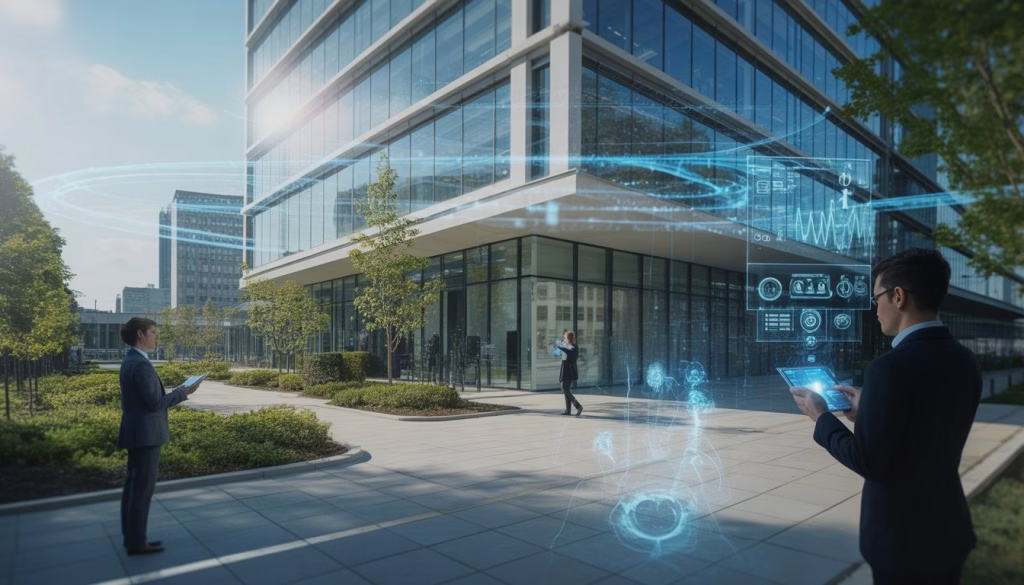
Smart buildings revolutionize how structures operate by integrating Internet of Things sensors, artificial intelligence, and automation systems to create self-regulating environments. Smart buildings are self-regulating, energy-efficient, and data-driven powerhouses that adapt to occupants’ needs in real time while optimizing energy consumption and operational costs. These intelligent structures go far beyond basic automation by converging various…
Read MoreWhat Are the Latest Loan Modification Trends in CRE?

Commercial real estate loan modifications have become a critical tool for borrowers facing financial challenges and market volatility. Lenders increasingly offer flexible modification terms to prevent foreclosures and maintain cash flow, with approval rates reaching approximately 60-70% for qualifying commercial properties. This represents a significant departure from pre-2020 lending practices when modifications were less common…
Read MoreHow Gross Rent Lease Works: A Complete Guide

A gross lease is a commercial lease where the tenant pays a flat fee that encompasses rent and all costs associated with ownership. This lease structure shifts the responsibility of operating expenses like property taxes, insurance, utilities, and maintenance from the tenant to the landlord. Understanding how gross leases work will help your commercial space…
Read MoreHow a General Partner in Investment Real Estate Creates Value

Investment real estate partnerships rely on two distinct roles that determine how deals are structured and managed. A general partner in investment real estate manages the day-to-day operations and decision-making of the partnership, overseeing everything from property acquisition to investor relations. Unlike limited partners who primarily provide capital, general partners take on unlimited liability in…
Read MoreWhy Choose a Gross Lease in Commercial Real Estate?

A gross lease is a commercial lease where the tenant pays a flat fee that covers rent and most property-related expenses. In this structure, the landlord assumes responsibility for taxes, insurance, utilities, and maintenance costs, streamlining payments for tenants. This lease type provides tenants with predictable monthly expenses and reduces the administrative burden of managing…
Read MoreCommercial Real Estate Delinquency Rates: A Wake‑Up Call

Commercial real estate delinquency rates reflect divergent risk profiles across property sectors. Office properties face unprecedented stress with CMBS delinquency rates reaching a record 11.8% in October 2025, while multifamily properties show delinquency rates of 7.1%. These figures highlight significant differences between property types and financing structures. Office CMBS delinquency rates now exceed Financial Crisis…
Read MoreWarning: Commercial Real Estate Delinquency Rates Soar

US commercial real estate delinquency rates have reached concerning levels in 2025, with significant implications for investors and the broader financial market. The US office delinquency rate spiked to 8.12% in September 2025, driven largely by major defaults including a $180 million loan backing a Manhattan office building. This represents a 42 basis point increase…
Read MoreFlexible Office Space Investing: Market Trends and Value

The US flexible office space market presents a compelling investment opportunity as commercial real estate undergoes significant transformation. The dedicated flexible office spaces market is projected to grow from $21.51 billion in 2025 to $61.70 billion by 2032, exhibiting a robust 16.24% CAGR, driven by the permanent shift toward hybrid work models and increasing demand…
Read MoreCo-Working Space Investment: Strategies and Market Insights

Co-working space investments present strong opportunities in the commercial real estate sector, fueled by the shift toward hybrid work arrangements. The sector supports various investment approaches, including direct property ownership, franchise opportunities, and equity stakes in established operators. Recent major acquisitions, such as CBRE’s $400 million acquisition of Industrious, which valued the co-working provider at…
Read More